
Comprehensive Outline
| Heading Level | Topic |
|---|---|
| H1 | How to Compress PDF Without Losing Quality: 15 Powerful Methods That Actually Work |
| H2 | Why PDF Compression Matters |
| H2 | Understanding How PDF Compression Works |
| H2 | Different Types of PDF Compression |
| H3 | Lossless Compression |
| H3 | Lossy Compression |
| H2 | Things to Do Before Compressing a PDF |
| H2 | Method 1: Use Adobe Acrobat Pro |
| H3 | Best Settings for High Quality |
| H2 | Method 2: Compress PDFs Using Microsoft Word |
| H2 | Method 3: Compress PDF with Preview on macOS |
| H2 | Method 4: Use Trusted Online PDF Compressors |
| H2 | Method 5: Compress PDFs Using Free Desktop Software |
| H2 | Common Mistakes to Avoid |
| H2 | Best Practices for Maintaining PDF Quality |
| H2 | Comparison Table of Compression Methods |
| H2 | Frequently Asked Questions |
| H2 | Conclusion |
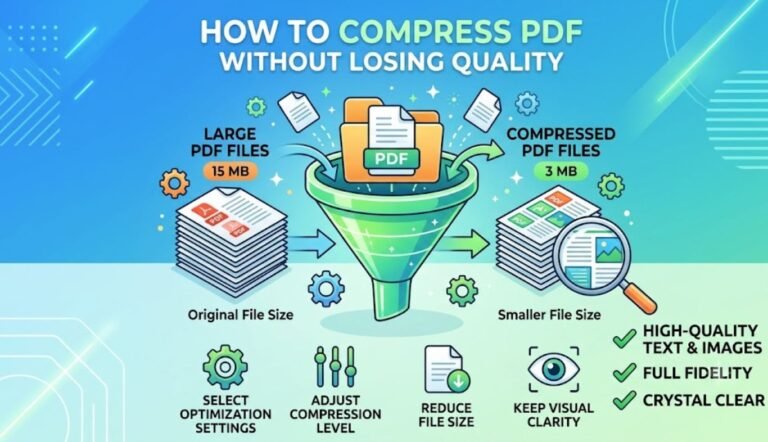
How to Compress PDF Without Losing Quality: 15 Powerful Methods That Actually Work
PDF files are among the most widely used document formats because they preserve formatting across devices and operating systems. Whether you’re sending contracts, sharing eBooks, uploading assignments, or submitting business documents, PDFs provide consistency and professionalism.
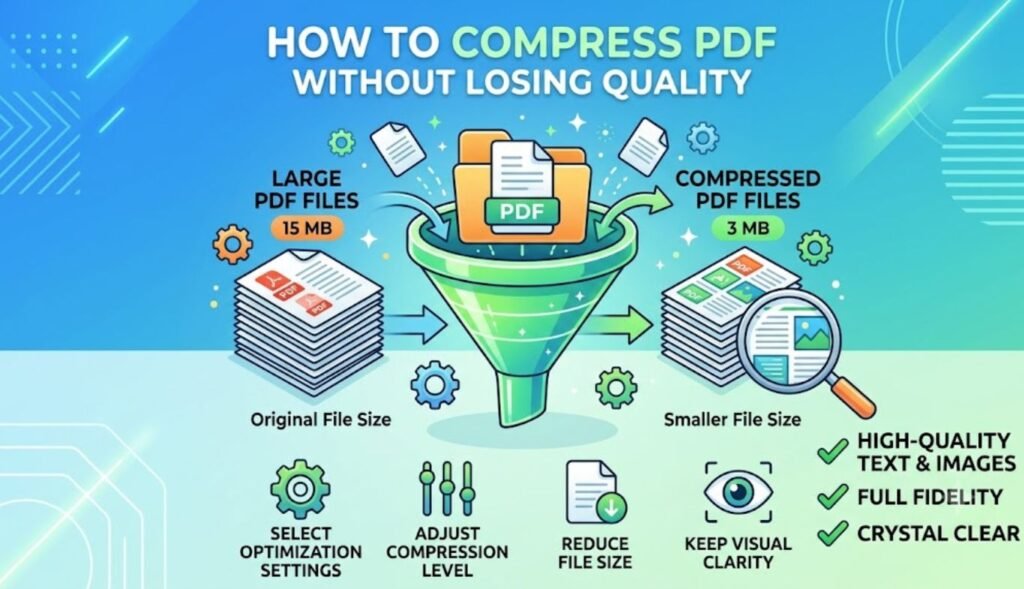
However, one common problem many users face is oversized PDF files. Large PDFs can be difficult to email, upload, or store in cloud services. Fortunately, learning how to compress PDF without losing quality allows you to reduce file size while keeping text crisp, images clear, and formatting intact.
In this comprehensive guide, you’ll discover proven compression methods, understand how PDF optimization works, and learn which tools deliver the best results. By the end, you’ll know exactly how to shrink PDF files without sacrificing readability or visual quality.
Why PDF Compression Matters
PDF compression isn’t just about saving storage space. It also improves document management, speeds up file sharing, and enhances user experience.
Here are several reasons why compression is important:
- Faster email attachments
- Quicker uploads to websites
- Reduced cloud storage usage
- Improved website loading speed
- Easier document archiving
- Better collaboration among teams
Many organizations also impose strict upload limits. Government portals, universities, and job application websites often allow uploads of only 2 MB to 10 MB. Compressing PDFs ensures your documents meet these requirements without requiring multiple attempts.
Another benefit is mobile accessibility. Smaller PDFs open more quickly on smartphones and tablets, making them ideal for remote work and online learning.
Understanding How PDF Compression Works
Before learning how to compress PDF without losing quality, it’s helpful to understand what actually happens during compression.
A PDF contains multiple types of data, including:
- Images
- Fonts
- Metadata
- Vector graphics
- Embedded objects
- Text layers
Compression tools analyze each element individually.
Instead of simply shrinking the entire document, they optimize various components.
Common optimization techniques include:
- Removing duplicate objects
- Compressing embedded images
- Eliminating unused fonts
- Cleaning unnecessary metadata
- Rewriting document structure
- Optimizing object streams
Modern compression algorithms can significantly reduce file size while keeping documents visually identical.
This is known as lossless compression, which preserves every detail of the original document.
Different Types of PDF Compression
Understanding the available compression methods helps you choose the best approach for different situations.
Lossless Compression
Lossless compression reduces file size without removing visible information.
It works by reorganizing and encoding data more efficiently.
Advantages include:
- No image degradation
- Sharp text remains intact
- Professional print quality
- Safe for legal documents
- Perfect for business reports
This method is recommended whenever document quality is your highest priority.
Examples include:
- ZIP-style encoding
- Object stream optimization
- Font optimization
- Metadata cleanup
Lossless compression usually reduces file sizes by 10% to 40%, depending on the document.
Lossy Compression
Lossy compression removes some data that most people won’t notice.
Typically, it affects:
- High-resolution images
- Embedded photographs
- Color depth
- Image resolution
Advantages include:
- Much smaller files
- Faster uploads
- Better web performance
Potential disadvantages:
- Slight image softness
- Reduced zoom quality
- Less suitable for professional printing
When used carefully, lossy compression provides an excellent balance between size and quality.
Many modern PDF tools allow users to adjust compression levels, giving complete control over image quality.
Things to Do Before Compressing a PDF
Before compressing your PDF, spend a few minutes preparing the document. This simple step often produces much better results.
Remove Unnecessary Pages
Delete blank pages or duplicate content before compression.
A shorter document naturally creates a smaller file.
Optimize Images First
Large photographs account for most PDF file size.
If possible:
- Resize oversized images
- Crop unnecessary areas
- Save images in efficient formats
- Use appropriate resolutions
For example:
| Purpose | Recommended Resolution |
|---|---|
| 150 DPI | |
| Office documents | 200 DPI |
| High-quality printing | 300 DPI |
Eliminate Hidden Data
Many PDFs contain unnecessary information, including:
- Revision history
- Hidden layers
- Embedded thumbnails
- Comments
- Attachments
Removing these elements can noticeably reduce file size.
Save a Backup Copy
Always keep the original file.
This allows you to compare quality after compression and start over if necessary.
Method 1: Use Adobe Acrobat Pro
Adobe Acrobat Pro remains one of the most reliable solutions for anyone learning how to compress PDF without losing quality.
Because Adobe created the PDF format, its optimization engine is exceptionally advanced.
Steps
- Open your PDF in Adobe Acrobat Pro.
- Select File.
- Choose Save as Other.
- Click Reduced Size PDF or Optimized PDF.
- Select your desired compatibility settings.
- Save the optimized document.
Best Settings for High Quality
For the best balance between quality and file size:
| Setting | Recommendation |
|---|---|
| Image Downsampling | 300 DPI |
| Compression | JPEG High |
| Font Embedding | Keep Enabled |
| Transparency | Preserve |
| Metadata | Remove unnecessary information |
These settings typically reduce document size significantly while maintaining excellent visual quality.
Advantages
- Industry-leading optimization
- Excellent text clarity
- Fine control over settings
- Batch processing
- OCR compatibility
- Secure document handling
Disadvantages
- Paid software
- Higher system requirements
- Advanced features may require experience
Despite the subscription cost, professionals who regularly manage PDFs often consider Adobe Acrobat Pro the gold standard for compression and optimization.
Method 2: Compress PDFs Using Microsoft Word
If you don’t have Adobe Acrobat Pro, Microsoft Word offers a simple alternative for reducing PDF file sizes. While it isn’t a dedicated PDF optimization tool, it can effectively shrink documents that mainly contain text, basic graphics, and standard formatting.
This method is ideal for reports, resumes, assignments, and business documents originally created in Word.
Steps to Compress a PDF with Microsoft Word
- Open Microsoft Word.
- Click File > Open and select your PDF.
- Allow Word to convert the PDF into an editable document.
- Review the formatting and make any necessary adjustments.
- Click File > Save As.
- Choose PDF as the file format.
- Select Minimum Size (Publishing Online) if available.
- Save the new PDF.
Although this process recreates the PDF instead of directly compressing it, the exported file is often much smaller than the original.
Advantages
- Free for Microsoft Office users
- Easy to use
- No additional software required
- Good for text-heavy documents
Limitations
- Complex layouts may shift slightly.
- Interactive forms may not be preserved.
- Some fonts can change during conversion.
- Not ideal for image-heavy PDFs.
Method 3: Compress PDF with Preview on macOS
Mac users already have a built-in PDF tool called Preview, which includes a simple file size reduction feature.
For basic documents, Preview works surprisingly well without installing extra software.
How to Use Preview
- Open the PDF in Preview.
- Select File > Export.
- Choose Quartz Filter.
- Select Reduce File Size.
- Save the optimized PDF.
This option applies automatic compression settings that reduce image sizes while keeping documents readable.
When Should You Use Preview?
Preview works best for:
- School assignments
- Business reports
- Meeting notes
- Manuals
- Presentation handouts
If image quality is extremely important, compare the compressed file with the original before sharing it.
Method 4: Use Trusted Online PDF Compressors
Online PDF compression services have become incredibly popular because they require no installation and work on nearly every device.
They’re especially helpful when you’re using a public computer or switching between different operating systems.
Some reputable online tools include:
- Adobe Acrobat Online
- Smallpdf
- iLovePDF
- PDF24 Tools
- PDF2Go
These platforms generally allow you to upload a PDF, choose a compression level, and download the optimized version within minutes.
Benefits of Online Compressors
- Works on Windows, Mac, Linux, Android, and iPhone
- No software installation
- Fast processing
- User-friendly interfaces
- Many free options available
Things to Consider
Before uploading confidential files, review the provider’s privacy policy.
For sensitive documents containing financial records, legal agreements, or personal information, using offline software is often the safer choice.
Method 5: Compress PDFs Using Free Desktop Software
If you frequently need to optimize PDFs but don’t want to pay for premium software, several free desktop applications can deliver impressive results.
Popular choices include:
| Software | Platform | Best For |
|---|---|---|
| PDF24 Creator | Windows | General PDF optimization |
| PDFsam Basic | Windows, macOS, Linux | PDF management |
| LibreOffice Draw | Cross-platform | Editing and exporting PDFs |
| Ghostscript | Cross-platform | Advanced compression |
These tools allow you to reduce file sizes while maintaining high-quality text and graphics.
Many also include features such as:
- Batch processing
- File merging
- PDF splitting
- Password protection
- Metadata removal
Method 6: Reduce Image Resolution Before Creating the PDF
One of the easiest ways to keep PDFs small is to optimize images before converting your document into PDF format.
Large, high-resolution images account for the majority of oversized PDF files.
Recommended Image Resolutions
| Intended Use | Resolution |
|---|---|
| 150 DPI | |
| Digital viewing | 150–200 DPI |
| Office printing | 200 DPI |
| Professional printing | 300 DPI |
Avoid inserting images that are much larger than necessary.
For example, a 600 DPI photo used only for screen viewing dramatically increases file size without improving appearance.
Method 7: Remove Embedded Fonts
Fonts contribute to PDF size, especially when multiple font families or character sets are embedded.
Many PDF optimization tools allow you to:
- Remove unused fonts
- Embed only required characters
- Subset font data
This technique can noticeably reduce file size while maintaining document readability.
Method 8: Delete Hidden Metadata
Many users don’t realize that PDFs contain hidden information beyond visible content.
Examples include:
- Editing history
- Author information
- Comments
- Attachments
- Hidden objects
- Unused bookmarks
Cleaning this metadata not only reduces file size but also improves privacy when sharing documents externally.
Method 9: Flatten Layers
Design software such as Adobe Illustrator and InDesign often exports PDFs containing multiple editable layers.
Flattening these layers merges them into a single visual layer, reducing complexity and decreasing file size.
This technique is particularly useful for:
- Posters
- Flyers
- Brochures
- Marketing materials
Always keep an editable source file before flattening layers.
Method 10: Save as an Optimized PDF
Many professional PDF editors include an Optimize PDF or Save as Optimized PDF option.
These features automatically:
- Compress images
- Remove duplicate objects
- Optimize fonts
- Delete unused resources
- Reorganize internal file structures
Because the optimization process targets multiple components simultaneously, it often produces better results than basic compression alone.
Common Mistakes to Avoid
Even when learning how to compress PDF without losing quality, it’s easy to make mistakes that reduce readability or damage document formatting.
Avoid these common errors:
- Compressing the same PDF multiple times
- Using extremely low image resolutions
- Removing essential fonts
- Forgetting to keep a backup copy
- Choosing maximum compression for print documents
- Uploading confidential files to untrusted websites
Taking a few extra minutes to review your settings can prevent unnecessary quality loss.
Best Practices for Maintaining PDF Quality
Follow these recommendations whenever you compress PDFs:
- Start with a clean, well-organized document.
- Use high-quality source images.
- Compress only once whenever possible.
- Compare the compressed file with the original.
- Test hyperlinks, bookmarks, and forms.
- Keep a master copy for future editing.
- Select lossless compression whenever document quality is critical.
- Choose reputable software for important files.
Following these practices ensures your compressed PDFs remain professional, readable, and easy to share.
Comparison Table of Popular PDF Compression Methods
| Method | Ease of Use | Quality Preservation | Cost | Best For |
|---|---|---|---|---|
| Adobe Acrobat Pro | Excellent | Excellent | Paid | Professionals |
| Microsoft Word | Very Easy | Good | Office License | Simple documents |
| Preview (macOS) | Easy | Good | Free | Mac users |
| Online Compressors | Very Easy | Good | Free/Paid | Quick tasks |
| PDF24 Creator | Easy | Very Good | Free | Windows users |
| Ghostscript | Advanced | Excellent | Free | Power users |
Each option offers a different balance between convenience, features, and file size reduction. Select the one that best matches your workflow and document requirements.
Method 11: Compress PDFs Using Mobile Apps
If you frequently work on the go, mobile PDF apps can help you reduce file sizes without needing a desktop computer.
Popular apps available for Android and iOS include:
- Adobe Acrobat Reader
- iLovePDF
- Smallpdf
- PDF Extra
- Xodo PDF Reader & Editor
These apps typically let you:
- Compress PDF files
- Merge or split documents
- Annotate PDFs
- Fill and sign forms
- Share compressed files directly via email or cloud storage
Best Practices for Mobile Compression
- Connect to a stable Wi-Fi network when uploading large files.
- Keep the original PDF as a backup.
- Use medium or high-quality compression for important documents.
- Preview the compressed PDF before sharing it.
Method 12: Batch Compress Multiple PDFs
Businesses, educators, and legal professionals often work with dozens—or even hundreds—of PDF files at once.
Instead of compressing each file individually, use software that supports batch processing.
Benefits of Batch Compression
- Saves significant time
- Applies consistent compression settings
- Reduces repetitive work
- Improves workflow efficiency
Batch processing is especially useful for:
- HR departments
- Accounting firms
- Law offices
- Schools and universities
- Marketing agencies
If you’re managing a large document library, this feature can dramatically improve productivity.
Method 13: Convert Scanned PDFs with OCR Before Compressio
Scanned PDFs are usually much larger than digitally created documents because every page is stored as an image.
Applying Optical Character Recognition (OCR) converts scanned text into searchable text while often reducing file size.
Advantages of OCR
- Smaller PDF files
- Searchable text
- Easier editing
- Better accessibility
- Improved indexing for document management systems
OCR is highly recommended for:
- Contracts
- Books
- Research papers
- Receipts
- Archived documents
Method 14: Remove Unnecessary Embedded Objects
Some PDFs contain extra elements that increase file size without adding value.
Examples include:
- Audio files
- Videos
- Embedded documents
- JavaScript
- Unused annotations
- File attachments
Removing these items can significantly decrease file size while keeping the main content intact.
Before deleting embedded objects, verify they aren’t required for the document’s intended purpose.
Method 15: Archive PDFs in ZIP Format
If you don’t need to edit a PDF immediately, placing it inside a ZIP archive provides another layer of compression.
While ZIP compression won’t reduce every PDF dramatically, it can still save storage space—especially for text-based documents.
ZIP archives are useful for:
- Emailing multiple PDFs
- Backing up files
- Long-term storage
- Sharing document collections
Remember that recipients must extract the archive before opening the files.
Expert Tips for Compressing PDFs Without Losing Quality
Professionals who regularly handle PDF documents follow several best practices to maximize quality while minimizing file size.
Choose the Right Compression Level
Avoid selecting the highest compression setting by default.
Instead:
- Use Low Compression for print-ready documents.
- Use Medium Compression for office documents.
- Use High Compression only for web sharing when a smaller file is more important than image detail.
Compress Images Before Creating the PDF
Optimizing images before exporting to PDF often produces better results than compressing afterward.
Use Standard Fonts
Standard fonts require less embedded data, reducing the final PDF size.
Update Your Software
Modern PDF applications use improved compression algorithms that often outperform older versions.
Test Before Sharing
Always verify:
- Text clarity
- Image sharpness
- Hyperlinks
- Bookmarks
- Forms
- Digital signatures
A quick review helps ensure the compressed document still meets professional standards.
Frequently Asked Questions (FAQs)
1. Can I compress a PDF without losing any quality?
Yes. By using lossless compression, you can reduce file size without noticeably affecting text, graphics, or document formatting. The exact reduction depends on the content of the PDF.
2. Why is my PDF still large after compression?
Large PDFs often contain high-resolution images, embedded fonts, multimedia files, or scanned pages. Further optimization—such as resizing images or removing unnecessary metadata—may be needed.
3. What is the best file size for emailing a PDF?
Many email providers allow attachments up to 20–25 MB, but keeping PDFs below 10 MB improves upload speed and recipient convenience.
4. Are online PDF compressors safe?
Reputable services generally use encrypted connections and automatically delete uploaded files after processing. However, avoid uploading confidential or sensitive documents unless you’re confident in the provider’s security and privacy practices.
5. Does compressing a PDF reduce print quality?
Not necessarily. If you use appropriate settings, especially lossless compression or high-quality image compression, the document should remain suitable for professional printing.
6. Which method is best for beginners?
Online PDF compressors and built-in tools such as Microsoft Word or Preview on macOS are excellent starting points because they require minimal technical knowledge.
7. Can I compress scanned PDFs?
Yes. Applying OCR, reducing image resolution where appropriate, and optimizing embedded images can significantly reduce the size of scanned PDFs while improving usability.
Final Thoughts
Learning how to compress PDF without losing quality is an essential skill for students, professionals, business owners, and anyone who regularly works with digital documents.
Whether you choose Adobe Acrobat Pro, Microsoft Word, Preview on macOS, trusted online tools, or free desktop software, the key is selecting the right compression method for your specific needs. By understanding the difference between lossless and lossy compression, optimizing images before creating PDFs, removing unnecessary metadata, and following best practices, you can achieve substantial file size reductions while preserving the quality of your documents.
Smaller PDFs are easier to upload, faster to share, and more convenient to store. With the techniques covered in this guide, you can confidently optimize your files for email, cloud storage, web publishing, or professional printing without compromising readability or appearance.