
Introduction
Managing projects doesn’t have to be expensive. Today, businesses of every size can access the best free project management software without paying costly subscription fees. Whether you’re a freelancer, startup founder, student, nonprofit organization, or enterprise team testing new workflows, free project management platforms provide everything needed to stay organized.
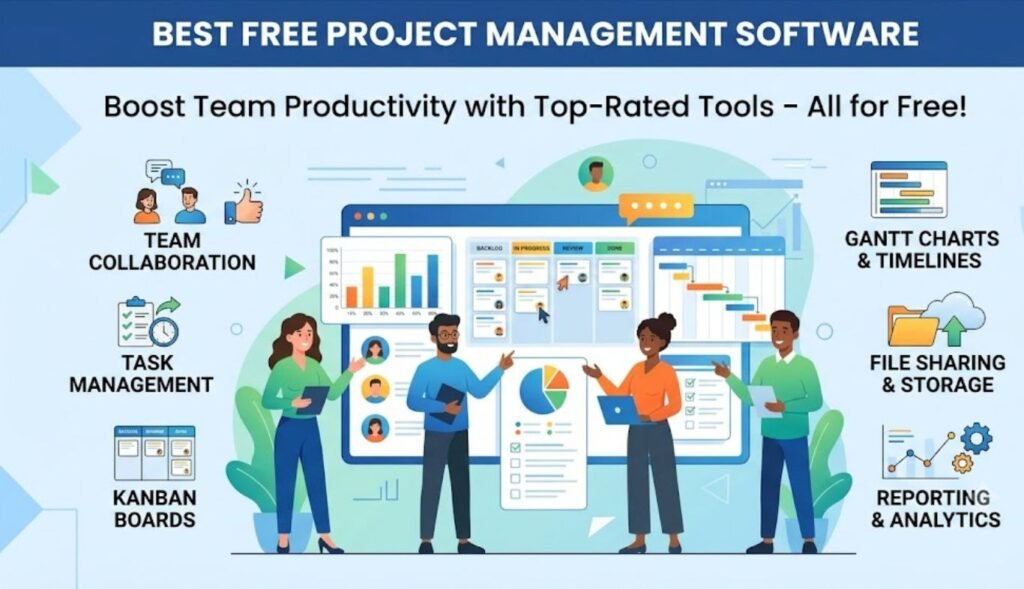
Modern project management tools now include task management, team collaboration, Kanban boards, Gantt charts, time tracking, file sharing, workflow automation, reporting dashboards, and mobile apps. Many free plans offer generous features that help teams complete projects efficiently while improving communication.
This comprehensive guide explores the best free project management software, compares leading platforms, explains essential features, and helps you choose the right solution for your needs.
Comprehensive Article Outline
| Heading Level | Topic |
|---|---|
| H1 | Best Free Project Management Software: Ultimate Guide to 15 Powerful Tools |
| H2 | Why Free Project Management Software Matters |
| H2 | Key Features Every Project Management Tool Should Include |
| H2 | Best Free Project Management Software Compared |
| H2 | Trello Review |
| H2 | Asana Review |
| H2 | ClickUp Review |
| H2 | Notion Review |
| H2 | Monday.com Free Plan |
| H2 | Jira Free Edition |
| H2 | Wrike Free Version |
| H2 | Teamwork Free Plan |
| H2 | Zoho Projects |
| H2 | Open Source Project Management Solutions |
| H2 | How to Choose the Right Software |
| H2 | Common Mistakes to Avoid |
| H2 | Future Trends in Project Management |
| H2 | Frequently Asked Questions |
| H2 | Conclusion |
Why Free Project Management Software Matters
Project management has changed dramatically over the past decade. Businesses no longer rely on spreadsheets, endless email chains, or handwritten notes to organize work. Instead, digital collaboration platforms help teams plan projects, assign tasks, monitor deadlines, and communicate in one place.
The best free project management software gives organizations access to professional productivity tools without increasing operational costs. This is especially valuable for startups, freelancers, educational institutions, nonprofit organizations, and small businesses operating on limited budgets.
Free software also allows companies to experiment with different workflows before committing to premium subscriptions. Many organizations begin with free plans and upgrade only when advanced automation, larger storage capacity, or enterprise-level security becomes necessary.
Another major advantage is accessibility. Cloud-based project management platforms let team members collaborate from anywhere using laptops, tablets, or smartphones. Remote employees, hybrid teams, and distributed organizations can stay connected regardless of location.
Modern platforms also improve transparency. Managers can instantly see project progress, identify delays, allocate resources more effectively, and ensure every team member understands their responsibilities.
Some of the biggest benefits include:
- Better team collaboration
- Improved deadline tracking
- Centralized communication
- Task prioritization
- Workflow visibility
- Document management
- Productivity monitoring
- Resource allocation
- Real-time notifications
- Mobile accessibility
These advantages explain why millions of teams worldwide now depend on project management applications every day.
Key Features Every Project Management Tool Should Include
Not every free platform offers the same capabilities. While comparing options, focus on features that directly improve productivity rather than simply choosing the platform with the longest feature list.
Task Management
Every project begins with tasks. A quality platform allows users to create, assign, organize, prioritize, and monitor tasks with ease.
Useful task management features include:
- Due dates
- Task owners
- Priority labels
- Status updates
- Dependencies
- Recurring tasks
- Attachments
- Comments
These capabilities ensure every team member knows exactly what needs to be completed.
Collaboration Tools
Successful projects depend on communication. Integrated collaboration eliminates the need for scattered emails and messaging apps.
Look for features like:
- Team comments
- File sharing
- Mentions
- Activity history
- Notifications
- Shared workspaces
These tools encourage faster decision-making and reduce misunderstandings.
Kanban Boards
Kanban boards provide a visual workflow where tasks move between stages such as:
- To Do
- In Progress
- Review
- Completed
This method makes project status easy to understand at a glance.
Calendar View
Calendars help managers visualize deadlines and upcoming milestones. They also simplify workload balancing across multiple team members.
Reporting Dashboards
Analytics help managers understand:
- Completed work
- Pending tasks
- Team productivity
- Missed deadlines
- Resource utilization
Even free versions often provide basic reporting capabilities.
File Storage
Centralized document storage prevents version confusion. Team members always access the latest files rather than searching through email attachments.
Mobile Applications
Remote work has increased the importance of mobile project management.
A strong mobile application allows users to:
- Update tasks
- Upload files
- Receive notifications
- Comment on projects
- Track deadlines
from anywhere.
Integrations
Many project management platforms connect with popular business tools, including:
- Google Workspace
- Microsoft 365
- Slack
- Zoom
- Dropbox
- GitHub
- Google Drive
Integrations reduce manual work and improve workflow efficiency.
Best Free Project Management Software Compared
Choosing the ideal platform depends on your team’s size, workflow, technical expertise, and collaboration style. The comparison below highlights several leading options.
| Software | Best For | Free Plan | Ease of Use |
|---|---|---|---|
| Trello | Visual task management | Excellent | Very Easy |
| ClickUp | All-in-one productivity | Excellent | Moderate |
| Asana | Team collaboration | Excellent | Easy |
| Notion | Documentation and planning | Excellent | Moderate |
| Jira | Software development | Excellent | Moderate |
| Wrike | Business teams | Good | Easy |
| Teamwork | Client projects | Good | Easy |
| Zoho Projects | Small businesses | Good | Easy |
| Monday.com | Workflow management | Limited | Very Easy |
Each platform has strengths that suit different project environments.
Trello Review
Trello remains one of the most recognizable names in project management. Its intuitive Kanban board system makes it an excellent choice for beginners while remaining powerful enough for experienced professionals.
Users organize projects using boards, lists, and cards. Every task becomes a card containing descriptions, due dates, attachments, labels, checklists, and team discussions.
Advantages
- Extremely beginner friendly
- Fast setup
- Excellent visual interface
- Mobile apps
- Power-Up integrations
- Custom labels
- Automation features
Limitations
The free version offers generous functionality but restricts advanced automation, larger workspaces, and premium administrative controls.
For freelancers, students, and small teams, however, Trello remains among the best free project management software solutions available today.
Asana Review
Asana focuses on helping teams coordinate complex work while keeping projects organized. It supports multiple project views including lists, boards, calendars, and timelines.
One major strength is workflow organization. Managers can assign responsibilities, create recurring tasks, establish dependencies, and monitor overall project health from centralized dashboards.
The free version supports collaborative task management for small teams while maintaining a clean interface that minimizes the learning curve.
Key benefits include:
- Project templates
- Calendar view
- Team collaboration
- Milestone tracking
- File attachments
- Multiple project layouts
- Mobile applications
Asana works particularly well for marketing departments, agencies, HR teams, and creative organizations managing multiple simultaneous projects.
ClickUp Review
ClickUp has quickly become one of the best free project management software options because it combines project planning, document management, goal tracking, collaboration, and reporting in one platform. Instead of switching between multiple applications, teams can manage nearly every aspect of a project from a single dashboard.
The free plan is one of the most generous available. It includes unlimited tasks, customizable views, collaborative documents, whiteboards, sprint management, and built-in chat for small teams.
Key Features
- Unlimited tasks
- Multiple project views
- Kanban boards
- Gantt charts
- Calendar view
- Time tracking
- Goal management
- Docs and Wikis
- Whiteboards
- Dashboards
ClickUp also allows users to customize workspaces according to their workflow. Teams can create custom fields, automate repetitive tasks, and organize information exactly how they prefer.
Pros
- Feature-rich free plan
- Excellent customization
- Modern interface
- Strong collaboration features
- Supports Agile and Scrum workflows
Cons
- Can feel overwhelming for beginners
- Large number of settings requires some learning
For growing businesses and teams that want an all-in-one productivity platform, ClickUp is an outstanding choice.
Notion Review
Notion combines note-taking, knowledge management, documentation, and project planning into one flexible workspace. Unlike traditional project management software, Notion allows users to build customized systems that fit their unique needs.
Small businesses, students, content creators, and startups appreciate its flexibility because pages can include databases, calendars, Kanban boards, task lists, meeting notes, and documentation.
Why Teams Love Notion
- Beautiful workspace
- Easy collaboration
- Powerful templates
- Flexible databases
- Knowledge management
- Team wiki
- Cross-platform support
Instead of forcing users into predefined workflows, Notion lets each organization build its own project management system.
Best Uses
- Editorial calendars
- Content planning
- Business documentation
- Product roadmaps
- Personal productivity
- Team knowledge base
Although advanced automation requires paid plans, the free version offers excellent value for individuals and smaller teams.
Monday.com Free Plan
Monday.com is known for its colorful interface and user-friendly workflow management system. It helps organizations track projects visually using boards, timelines, calendars, and dashboards.
The free plan is designed primarily for individuals and very small teams. While it has user limitations, it still provides enough functionality for startups or freelancers testing the platform.
Features
- Project boards
- Task tracking
- File sharing
- Collaboration
- Mobile apps
- Activity logs
- Dashboard widgets
Its drag-and-drop interface makes organizing work simple, even for users with little technical experience.
Strengths
- Clean interface
- Fast learning curve
- Excellent visualization
- Reliable mobile experience
Weaknesses
- Limited users on free plan
- Advanced automation requires upgrading
Monday.com works particularly well for marketing campaigns, event planning, customer management, and internal business operations.
Jira Free Edition
Jira has become the industry standard for software development teams practicing Agile methodologies. Developed with developers in mind, it supports Scrum, Kanban, sprint planning, backlog management, bug tracking, and release planning.
The free edition supports up to several users, making it suitable for startups and development teams.
Core Features
- Sprint planning
- Backlog management
- Kanban boards
- Scrum boards
- Issue tracking
- Roadmaps
- Reporting
- Automation
Advantages
Software developers appreciate Jira because it integrates seamlessly with popular development tools such as Git repositories and continuous integration platforms.
Limitations
Non-technical users may find Jira more complex than general project management software because it includes developer-focused terminology and workflows.
If your organization builds software products, Jira is among the strongest free options available.
Wrike Free Version
Wrike offers a balanced combination of project planning, collaboration, and reporting. Its interface supports both beginners and experienced project managers.
The free version includes task management, board view, file sharing, and real-time collaboration.
Main Benefits
- Centralized workspace
- Task management
- File collaboration
- Activity streams
- Mobile support
- Cloud storage integration
Wrike emphasizes transparency by allowing managers to monitor work progress through visual dashboards.
Ideal For
- Marketing teams
- Agencies
- HR departments
- Consulting firms
- Business operations
As organizations expand, Wrike’s premium plans unlock workload management, advanced reporting, automation, and resource planning.
Teamwork Free Plan
Teamwork is especially popular among agencies and businesses managing client projects. Its project organization tools help teams monitor deadlines, assign responsibilities, and collaborate efficiently.
The free version offers core project management capabilities while maintaining an easy-to-use interface.
Features
- Task lists
- Milestones
- Time tracking
- File management
- Team collaboration
- Project templates
Unlike many competitors, Teamwork focuses heavily on client services, making it useful for consulting firms, marketing agencies, and freelancers.
Advantages
- Easy navigation
- Client-friendly workflows
- Time management
- Good collaboration tools
Disadvantages
- Limited advanced reporting
- Premium features require upgrading
Zoho Projects
Zoho Projects is part of the broader Zoho ecosystem, making it attractive for businesses already using Zoho CRM, Zoho Books, or Zoho Mail.
The free version includes essential project planning features while maintaining excellent integration with other Zoho products.
Included Features
- Task management
- Milestones
- Document sharing
- Discussion forums
- Calendar
- Basic reporting
- Time logs
Zoho Projects provides a straightforward interface suitable for startups and small businesses.
Why Choose Zoho Projects?
Companies seeking an affordable long-term solution often begin with the free plan before expanding into the complete Zoho business suite.
Open Source Project Management Solutions
While cloud-based software dominates today’s market, open source project management platforms remain popular among organizations requiring complete control over their infrastructure.
Unlike commercial services, open source software allows developers to customize functionality and host applications on private servers.
Some well-known open source options include:
| Platform | Best For | Self-Hosted | Customization |
|---|---|---|---|
| OpenProject | Enterprise teams | Yes | Excellent |
| Redmine | Software development | Yes | Excellent |
| Taiga | Agile teams | Yes | Very Good |
| Plane | Modern Agile management | Yes | Excellent |
Advantages of Open Source Software
- Full ownership of data
- High customization
- Strong privacy
- Community-driven development
- No vendor lock-in
- Flexible deployment
Challenges
Organizations must also consider:
- Server maintenance
- Technical expertise
- Software updates
- Security management
- Backup responsibilities
For businesses with experienced IT teams, open source solutions provide exceptional flexibility.
How to Choose the Right Software
Selecting the best free project management software depends on your team’s goals rather than simply choosing the platform with the most features.
Consider these important factors before making a decision:
Team Size
Small teams often benefit from simple tools like Trello or Notion, while larger organizations may require ClickUp or Jira.
Project Complexity
Simple task lists may only require Kanban boards. Complex projects often need Gantt charts, dependencies, reporting, and workload management.
Ease of Use
Software with an intuitive interface reduces training time and encourages team adoption.
Collaboration Features
Look for:
- Comments
- File sharing
- Notifications
- Mentions
- Team workspaces
- Shared calendars
Integrations
Choose software that works with your existing business tools, such as email platforms, cloud storage, communication apps, and customer relationship management systems.
Scalability
Although you may start with a free plan, select software that can grow alongside your business without requiring a complete migration later.
By evaluating these factors carefully, you can confidently select a platform that supports productivity today and scales with your future needs.
Common Mistakes to Avoid When Using Free Project Management Software
Even the best free project management software cannot improve productivity if it is not implemented correctly. Many teams adopt a new platform with enthusiasm but fail to establish clear processes, resulting in confusion instead of efficiency.
Here are some of the most common mistakes and how to avoid them.
Choosing Software Based Only on Popularity
A tool that works well for one business may not suit another. Before selecting software, consider your team size, workflow, industry, and long-term goals rather than simply choosing the most well-known platform.
Ignoring Team Training
Even intuitive platforms require some onboarding. Spend time introducing team members to the software, explaining workflows, and establishing consistent naming conventions for tasks and projects.
Creating Too Many Projects
Avoid creating unnecessary workspaces or duplicate projects. Organize work logically so everyone knows where to find documents, tasks, and updates.
Not Using Tags and Priorities
Labels, priorities, and categories help users quickly identify urgent work. Without them, important tasks can easily become buried under less critical activities.
Forgetting Regular Updates
A project management tool is only effective when information remains current. Encourage team members to update task statuses, deadlines, and comments regularly.
Overcomplicating Workflows
Many platforms offer extensive customization. While flexibility is useful, creating too many stages, automations, or custom fields can overwhelm users. Start with a simple workflow and expand only when necessary.
Skipping Integrations
Integrating your project management software with communication, storage, and productivity tools can eliminate repetitive work and improve collaboration.
By avoiding these common mistakes, teams can maximize the value of free project management platforms and maintain organized, transparent workflows.
Future Trends in Project Management Software
Project management technology continues to evolve rapidly. Artificial intelligence, automation, and cloud computing are transforming how organizations plan and execute work.
Artificial Intelligence
AI-powered assistants are becoming standard features. They can:
- Suggest task priorities
- Predict project delays
- Generate reports
- Summarize meetings
- Recommend workflow improvements
- Automate repetitive administrative tasks
Advanced Automation
Automation reduces manual effort by handling recurring processes such as:
- Task assignments
- Deadline reminders
- Status updates
- Approval workflows
- Notifications
This allows teams to focus on strategic work rather than administrative tasks.
Hybrid Work Support
As remote and hybrid work environments continue to grow, project management platforms are improving collaboration through:
- Video conferencing integrations
- Shared digital workspaces
- Real-time document editing
- Cloud file management
- Mobile accessibility
Better Analytics
Future dashboards will provide deeper insights into:
- Resource allocation
- Productivity trends
- Budget forecasting
- Project risks
- Team performance
These analytics will help managers make informed decisions based on real-time data.
Stronger Security
Organizations increasingly prioritize data protection. Future platforms are expected to include enhanced encryption, multi-factor authentication, role-based permissions, and compliance with international security standards.
These innovations will continue to shape the future of the best free project management software, making it even more powerful and accessible for businesses of all sizes.
Frequently Asked Questions
1. What is the best free project management software?
The best option depends on your specific requirements. Trello is ideal for visual task management, ClickUp offers a feature-rich all-in-one workspace, Asana excels at collaboration, Notion is highly flexible, and Jira is excellent for software development teams.
2. Is free project management software suitable for businesses?
Yes. Many startups, nonprofits, educational institutions, and small businesses successfully manage projects using free plans. As organizations grow, they can upgrade to premium features if needed.
3. What features should I look for?
Important features include:
- Task management
- Team collaboration
- File sharing
- Kanban boards
- Calendar view
- Reporting dashboards
- Mobile applications
- Workflow automation
- Third-party integrations
4. Can free project management software support remote teams?
Absolutely. Most modern platforms are cloud-based and allow distributed teams to collaborate in real time through shared workspaces, comments, notifications, and mobile apps.
5. Which project management software is easiest for beginners?
Trello and Monday.com are often considered the easiest platforms due to their intuitive drag-and-drop interfaces and simple learning curve.
6. When should I upgrade from a free plan?
Consider upgrading when your team requires advanced automation, larger storage capacity, detailed reporting, enhanced security controls, or support for a greater number of users.
7. Are free project management tools secure?
Reputable providers implement strong security measures, including encrypted data transmission, user authentication, and regular backups. Always review the provider’s security documentation before storing sensitive business information.
Helpful External Resource
To learn more about project management best practices and globally recognized standards, visit the Project Management Institute (PMI): https://www.pmi.org
Conclusion
Choosing the best free project management software can significantly improve the way individuals and teams organize work, communicate, and achieve project goals. Whether you need a simple Kanban board, a comprehensive productivity suite, or an Agile-focused development platform, there is a free solution that fits your workflow.
Trello remains an excellent choice for visual task management, ClickUp delivers an impressive all-in-one experience, Asana simplifies collaboration, Notion provides unmatched flexibility, and Jira continues to lead software development teams. Wrike, Teamwork, Zoho Projects, and several open-source alternatives also offer valuable capabilities for different industries and project requirements.
Before making a decision, evaluate your team’s size, preferred workflow, integration needs, scalability, and collaboration style. Testing a few platforms through their free plans is an effective way to determine which solution aligns best with your goals.
Ultimately, the right software is the one your team will consistently use. By implementing clear processes, keeping projects organized, and leveraging available features, you can increase productivity without increasing costs.
Invest time in selecting the right platform today, and you’ll create a stronger foundation for successful projects tomorrow.