
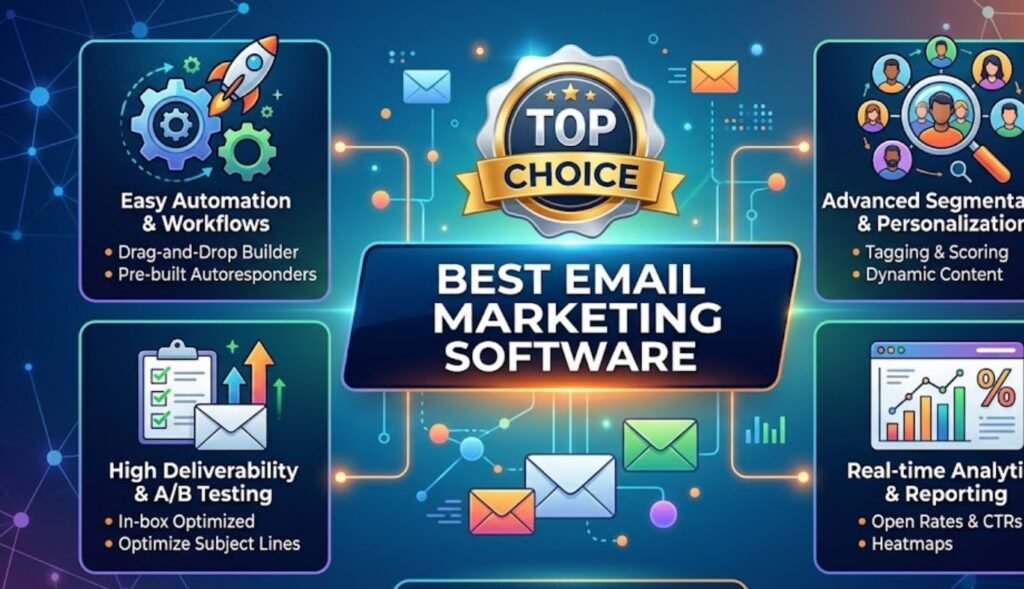
Email marketing continues to be one of the highest-return digital marketing strategies available today. Whether you’re a blogger, entrepreneur, eCommerce owner, or enterprise marketer, choosing the best email marketing software can dramatically improve customer engagement, increase conversions, and build long-term relationships with your audience.
According to industry research, email marketing consistently delivers one of the highest returns on investment (ROI), often generating multiple dollars in revenue for every dollar spent. However, success doesn’t come from simply sending newsletters—it depends on selecting the right platform with automation, segmentation, personalization, analytics, and deliverability features.
In this comprehensive guide, you’ll discover the leading email marketing platforms, their standout features, pricing considerations, and practical tips to help you make an informed decision.
Comprehensive Outline
| Heading | Subtopics Covered |
|---|---|
| Introduction | Importance of email marketing, ROI, software overview |
| What Is Email Marketing Software? | Definition, benefits, key capabilities |
| Why Businesses Need Email Marketing Software | Automation, personalization, analytics, scalability |
| Essential Features to Look For | Automation, templates, segmentation, reporting, integrations |
| Top Email Marketing Platforms | Comparison of leading tools |
| Best Software for Small Businesses | Budget-friendly options |
| Best Enterprise Solutions | Advanced automation and CRM integration |
| Email Automation Explained | Workflows, triggers, drip campaigns |
| Deliverability Best Practices | Authentication, list hygiene, engagement |
| AI in Email Marketing | Personalization, predictive analytics |
| Common Mistakes to Avoid | Spam, poor segmentation, excessive emailing |
| Expert Tips | Improving open rates and conversions |
| Comparison Table | Feature-by-feature overview |
| Frequently Asked Questions | Six detailed FAQs |
| Conclusion | Final recommendations |
What Is Email Marketing Software?
Email marketing software is a digital platform that enables businesses to create, send, automate, and monitor email campaigns efficiently. Instead of manually emailing customers one by one, marketers can use these platforms to communicate with thousands—or even millions—of subscribers at the same time.
The best email marketing software simplifies every stage of an email campaign, from designing professional newsletters to analyzing campaign performance through detailed reports.
Modern platforms have evolved beyond simple email delivery. Today, they provide advanced capabilities such as:
- Marketing automation
- Customer segmentation
- Personalized messaging
- Behavioral tracking
- A/B testing
- Landing page creation
- CRM integration
- AI-powered content suggestions
These features help businesses send the right message to the right audience at the right time.
Key Functions
| Feature | Purpose |
|---|---|
| Email Campaigns | Send newsletters and promotions |
| Automation | Trigger emails automatically |
| Analytics | Measure campaign performance |
| Templates | Create professional emails quickly |
| Personalization | Increase engagement |
| Segmentation | Target specific audiences |
| Integrations | Connect with CRM and eCommerce tools |
How Email Marketing Software Works
A typical email marketing workflow follows these steps:
- Build an email list.
- Segment subscribers.
- Design an email.
- Schedule or automate delivery.
- Monitor analytics.
- Optimize future campaigns.
This streamlined process saves time while delivering highly relevant content to subscribers.
Benefits of Using Email Marketing Platforms
Organizations of every size benefit from email marketing software because it provides:
- Faster communication
- Better customer relationships
- Higher conversion rates
- Consistent branding
- Increased website traffic
- Measurable campaign performance
- Improved customer retention
Small businesses especially benefit because automation allows them to compete with much larger organizations without hiring large marketing teams.
Who Should Use Email Marketing Software?
Almost every industry can benefit, including:
- Bloggers
- Content creators
- Online stores
- SaaS companies
- Educational institutions
- Healthcare organizations
- Real estate agencies
- Financial services
- Nonprofits
- Marketing agencies
Regardless of industry, effective email marketing helps maintain customer relationships while generating repeat business.
Popular Types of Email Campaigns
Businesses commonly send:
- Welcome emails
- Promotional campaigns
- Product launches
- Event invitations
- Seasonal offers
- Cart abandonment reminders
- Educational newsletters
- Customer surveys
- Re-engagement campaigns
- Loyalty rewards
Each campaign serves a unique purpose and contributes to a comprehensive digital marketing strategy.
Why Email Marketing Remains So Effective
Unlike social media platforms, where algorithms determine visibility, email gives businesses direct access to their audience.
Some major advantages include:
- Direct customer communication
- High ROI
- Strong personalization
- Reliable audience ownership
- Easy performance tracking
- Cost-effective marketing
Furthermore, subscribers who voluntarily join your email list are generally more interested in your products or services, resulting in higher engagement compared to many other digital channels.
Why Businesses Need the Best Email Marketing Software
Choosing the best email marketing software isn’t just about sending emails—it’s about building meaningful customer journeys.
Today’s consumers expect personalized experiences. Generic mass emails no longer deliver the same results they once did. Modern platforms use automation and customer data to create relevant experiences for every subscriber.
Increased Productivity
Automation handles repetitive tasks such as:
- Welcome sequences
- Birthday emails
- Order confirmations
- Follow-up campaigns
- Customer onboarding
Instead of manually sending hundreds of emails, marketers create workflows once and allow the software to manage the process automatically.
Better Customer Segmentation
Not every customer shares the same interests.
Advanced platforms let businesses segment subscribers based on:
- Age
- Gender
- Location
- Purchase history
- Website activity
- Email engagement
- Customer lifecycle stage
As a result, subscribers receive more relevant messages, leading to higher open rates and improved conversions.
Improved Personalization
Personalized emails consistently outperform generic campaigns.
Modern software allows marketers to personalize:
- Customer names
- Product recommendations
- Purchase history
- Geographic location
- Interests
- Behavioral triggers
These customized experiences help increase trust and strengthen customer relationships.
Advanced Analytics
Understanding campaign performance is essential for continuous improvement.
The best email marketing software typically tracks:
| Metric | Why It Matters |
|---|---|
| Open Rate | Measures subject line effectiveness |
| Click-Through Rate | Indicates engagement |
| Bounce Rate | Shows delivery quality |
| Conversion Rate | Tracks campaign success |
| Unsubscribe Rate | Measures audience satisfaction |
| Revenue | Evaluates marketing ROI |
Using these insights, marketers can optimize future campaigns for better performance.
Automation Saves Time
Automation is perhaps the biggest reason businesses invest in premium email platforms.
Common automated workflows include:
- Welcome series
- Lead nurturing
- Abandoned cart reminders
- Customer onboarding
- Product recommendations
- Win-back campaigns
- Anniversary messages
- Subscription renewals
Once configured, these workflows continue operating around the clock with minimal maintenance.
Seamless Integrations
Modern businesses rely on multiple software platforms.
Leading email marketing tools integrate with:
- CRM systems
- eCommerce platforms
- Payment processors
- Webinar software
- Customer support tools
- Analytics platforms
- Social media applications
These integrations eliminate manual data entry and create a smoother customer experience.
Scalability for Business Growth
As your business expands, your email marketing platform should grow with it.
Premium solutions offer:
- Larger subscriber limits
- Advanced automation
- Multi-user collaboration
- Enterprise security
- AI-powered optimization
- Dedicated customer support
This scalability ensures businesses won’t outgrow their chosen platform.
Essential Features to Look for in the Best Email Marketing Software
Choosing the best email marketing software involves more than comparing prices. The ideal platform should support your current marketing goals while offering room to grow as your business expands. Below are the most important features to evaluate before making a decision.
1. Email Automation
Automation allows you to send emails based on user actions instead of manually creating every campaign.
Popular automation workflows include:
- Welcome email series
- Abandoned cart recovery
- Birthday and anniversary emails
- Lead nurturing campaigns
- Product recommendations
- Customer re-engagement campaigns
Automation helps businesses save time while delivering timely and personalized communication.
2. Drag-and-Drop Email Builder
Not everyone knows HTML or graphic design. A visual editor enables anyone to create professional emails within minutes.
Look for features such as:
- Responsive templates
- Image editing
- Content blocks
- Mobile previews
- Custom branding options
These tools make email creation simple, even for beginners.
3. Audience Segmentation
Segmentation improves campaign performance by sending relevant content to specific groups.
Subscribers can be segmented based on:
- Demographics
- Purchase history
- Geographic location
- Website behavior
- Email engagement
- Customer interests
Highly targeted campaigns often generate significantly better engagement than generic email blasts.
4. Personalization
Modern email marketing goes beyond simply inserting a customer’s first name.
Advanced personalization includes:
- Dynamic content
- Personalized product recommendations
- Location-based messaging
- Behavioral triggers
- Purchase history recommendations
Relevant content increases customer trust and encourages higher click-through rates.
5. Analytics and Reporting
Data-driven marketing delivers better results.
A quality platform should provide reports for:
| Report | Purpose |
|---|---|
| Open Rate | Measures subject line performance |
| Click Rate | Evaluates engagement |
| Bounce Rate | Indicates list quality |
| Conversion Rate | Tracks sales or signups |
| Revenue Reports | Measures campaign ROI |
| Device Reports | Understands mobile vs. desktop users |
These metrics help marketers improve future campaigns.
6. Integrations
Your email platform should connect seamlessly with the software you already use.
Popular integrations include:
- Customer Relationship Management (CRM)
- eCommerce stores
- Payment gateways
- Customer support software
- Webinar platforms
- Social media tools
- Website builders
Integrated systems reduce manual work and improve productivity.
7. Deliverability
The best-designed email has little value if it lands in the spam folder.
Reliable email marketing platforms prioritize:
- Sender authentication
- Spam testing
- Domain verification
- IP reputation
- List hygiene tools
High deliverability ensures your messages reach subscribers’ inboxes.
Top 12 Best Email Marketing Software Platforms
Below are some of the industry’s most trusted email marketing solutions.
1. Mailchimp
Mailchimp remains one of the most popular platforms for beginners and growing businesses.
Best For
- Small businesses
- Bloggers
- Startups
Key Features
- Marketing automation
- Landing pages
- Audience segmentation
- AI content suggestions
- Website builder
- Analytics dashboard
Pros
- Beginner-friendly interface
- Large template library
- Strong reporting tools
- Excellent integrations
Cons
- Premium plans become expensive
- Automation features vary by plan
2. Brevo (formerly Sendinblue)
Brevo combines email marketing with CRM capabilities.
Best For
- Small businesses
- Agencies
- Service providers
Features
- Unlimited contacts
- SMS marketing
- Marketing automation
- Transactional emails
- CRM tools
Advantages
- Affordable pricing
- Multi-channel communication
- Excellent automation
3. Constant Contact
Constant Contact has been serving businesses for decades.
Ideal Users
- Local businesses
- Nonprofits
- Event organizers
Features
- Email templates
- Event management
- Surveys
- Automation
- Social media scheduling
Pros
- Easy setup
- Helpful customer support
- Good template collection
4. GetResponse
GetResponse is much more than an email marketing platform.
It includes:
- Webinar hosting
- Sales funnels
- Marketing automation
- Website builder
- AI email creator
- Landing pages
It’s particularly useful for digital marketers who want multiple marketing tools within one platform.
5. ActiveCampaign
ActiveCampaign specializes in intelligent marketing automation.
Strengths
- Advanced workflows
- Predictive sending
- CRM integration
- Customer journey automation
- Behavioral tracking
Businesses looking for sophisticated automation frequently choose this platform.
6. ConvertKit (Kit)
Designed primarily for creators.
Ideal for:
- Bloggers
- Authors
- Coaches
- Online educators
- YouTubers
Features include:
- Visual automation
- Creator-focused landing pages
- Subscriber tagging
- Digital product selling
7. AWeber
AWeber continues to be a reliable choice for small businesses.
Highlights include:
- AI writing assistant
- Newsletter templates
- Landing pages
- Ecommerce integration
- Automation
Its simplicity makes it attractive for beginners.
8. Campaign Monitor
Campaign Monitor emphasizes beautiful email design.
Features:
- Professional templates
- Automation
- Customer journeys
- Personalization
- Detailed analytics
Many design-conscious brands prefer Campaign Monitor for its polished templates.
9. HubSpot Email Marketing
HubSpot combines email marketing with one of the world’s most popular CRM systems.
Capabilities include:
- Contact management
- Sales automation
- Marketing analytics
- AI tools
- Personalized campaigns
This platform is well suited for businesses seeking an all-in-one marketing ecosystem.
10. Omnisend
Omnisend focuses heavily on eCommerce.
Excellent for:
- Shopify stores
- WooCommerce
- BigCommerce
- Online retailers
Features include:
- Cart recovery
- Product recommendations
- SMS marketing
- Push notifications
- Automation workflows
11. Moosend
Moosend offers advanced marketing tools at competitive pricing.
Key features:
- Automation
- Landing pages
- AI recommendations
- Reporting
- Segmentation
Its affordability appeals to growing businesses.
12. MailerLite
MailerLite has become increasingly popular among startups and small businesses.
Features include:
- Drag-and-drop builder
- Landing pages
- Pop-ups
- Automation
- Website builder
- Subscriber management
Its clean interface makes campaign creation straightforward.
Comparison Table of the Best Email Marketing Software
| Platform | Best For | Automation | CRM | Landing Pages | Free Plan |
|---|---|---|---|---|---|
| Mailchimp | Beginners | ✔ | Limited | ✔ | ✔ |
| Brevo | SMBs | ✔ | ✔ | ✔ | ✔ |
| Constant Contact | Local Business | ✔ | Limited | ✔ | Trial |
| GetResponse | Digital Marketing | ✔✔ | ✔ | ✔ | Limited |
| ActiveCampaign | Automation | ✔✔✔ | ✔ | ✔ | Trial |
| ConvertKit | Creators | ✔✔ | Limited | ✔ | ✔ |
| AWeber | Beginners | ✔ | No | ✔ | ✔ |
| Campaign Monitor | Agencies | ✔ | Limited | ✔ | Trial |
| HubSpot | Enterprise | ✔✔✔ | ✔✔✔ | ✔ | Limited |
| Omnisend | eCommerce | ✔✔ | Limited | ✔ | ✔ |
| Moosend | Budget Users | ✔✔ | Limited | ✔ | Trial |
| MailerLite | Small Business | ✔✔ | No | ✔ | ✔ |
Best Email Marketing Software for Different Business Types
Small Businesses
Recommended platforms:
- MailerLite
- Brevo
- Mailchimp
- AWeber
Reasons:
- Affordable
- Easy to use
- Excellent templates
- Automation included
Bloggers and Content Creators
Top recommendations:
- ConvertKit
- MailerLite
- GetResponse
These platforms focus on audience growth, subscriber engagement, and digital product sales.
eCommerce Stores
Best options:
- Omnisend
- Klaviyo
- Mailchimp
- ActiveCampaign
Key eCommerce features include:
- Cart abandonment
- Product recommendations
- Customer segmentation
- Purchase tracking
Large Enterprises
Enterprise organizations benefit from:
- HubSpot
- ActiveCampaign
- Salesforce Marketing Cloud
- Adobe Campaign
These platforms provide advanced automation, security, collaboration tools, and enterprise-level reporting.
Pricing Considerations
When comparing platforms, consider:
- Monthly subscriber limits
- Email sending limits
- Automation availability
- Number of users
- API access
- Customer support
- Advanced reporting
The cheapest option isn’t always the best. Consider long-term scalability and feature availability.
Expert Tips Before Choosing an Email Marketing Platform
✔ Start with a free plan whenever possible.
✔ Consider future business growth.
✔ Test automation capabilities.
✔ Review integration options.
✔ Compare customer support quality.
✔ Evaluate reporting dashboards.
✔ Choose a platform with strong deliverability.
✔ Ensure GDPR and privacy compliance if applicable.
AI Is Transforming Email Marketing
Artificial intelligence (AI) has changed how businesses create, personalize, and optimize email campaigns. The best email marketing software now includes AI-powered features that save time while improving campaign performance.
Benefits of AI in Email Marketing
Modern AI tools can help marketers:
- Generate compelling subject lines
- Write email copy
- Recommend products based on customer behavior
- Predict the best time to send emails
- Automatically segment audiences
- Personalize content for each subscriber
- Analyze campaign performance
- Suggest improvements for future campaigns
These features reduce manual work and allow businesses to deliver more relevant messages to their audiences.
How AI Improves Customer Engagement
AI analyzes customer data such as browsing history, purchase behavior, and previous email interactions. Based on these insights, it can recommend products, personalize offers, and send emails when subscribers are most likely to open them.
For example, an online clothing store can automatically recommend products that match a customer’s previous purchases. This personalized experience often leads to higher click-through and conversion rates.
Email Deliverability Best Practices
Even the most beautifully designed email is ineffective if it never reaches the recipient’s inbox. Deliverability measures the likelihood that your emails will avoid spam folders and arrive successfully.
Authenticate Your Domain
Email authentication helps internet service providers verify that your emails are legitimate.
Important authentication methods include:
- SPF (Sender Policy Framework)
- DKIM (DomainKeys Identified Mail)
- DMARC (Domain-based Message Authentication, Reporting & Conformance)
Proper authentication improves sender reputation and boosts inbox placement.
Maintain a Clean Email List
Regularly remove:
- Invalid email addresses
- Inactive subscribers
- Hard bounces
- Spam complaints
A healthy email list improves engagement metrics and protects your sender reputation.
Avoid Spam Triggers
To reduce the risk of landing in spam folders:
- Avoid excessive capitalization
- Don’t overuse exclamation marks
- Limit spam-like phrases
- Use balanced text-to-image ratios
- Include an unsubscribe link
- Test emails before sending
Encourage Subscriber Engagement
Mailbox providers consider engagement when determining inbox placement.
Increase engagement by:
- Sending valuable content
- Personalizing emails
- Segmenting audiences
- Using clear calls-to-action
- Sending emails consistently
Higher engagement signals that your content is useful and trustworthy.
Common Email Marketing Mistakes to Avoid
Even experienced marketers can make mistakes that reduce campaign effectiveness.
1. Buying Email Lists
Purchased email lists often contain outdated or uninterested contacts. They can damage your sender reputation and increase spam complaints.
Instead, grow your list organically using:
- Website forms
- Lead magnets
- Webinars
- Free downloads
- Newsletters
2. Ignoring Mobile Optimization
A large percentage of emails are opened on mobile devices.
Always:
- Use responsive templates
- Keep subject lines concise
- Make buttons easy to tap
- Use readable font sizes
- Test on multiple devices
3. Sending Too Many Emails
Over-emailing may lead subscribers to:
- Ignore messages
- Unsubscribe
- Mark emails as spam
Maintain a consistent schedule and prioritize quality over quantity.
4. Neglecting A/B Testing
A/B testing allows marketers to compare different versions of an email.
Elements worth testing include:
- Subject lines
- Call-to-action buttons
- Images
- Email layouts
- Send times
- Personalization
Continuous testing helps improve campaign performance over time.
5. Forgetting Analytics
Many businesses focus only on open rates, but additional metrics provide deeper insights.
Monitor:
- Click-through rate
- Conversion rate
- Bounce rate
- Revenue generated
- Unsubscribe rate
- List growth
These metrics help identify strengths and areas for improvement.
Expert Tips for Email Marketing Success
To get the most from the best email marketing software, follow these proven strategies:
Build Trust
Provide valuable, relevant content rather than constant promotions. Educational emails, helpful tips, and exclusive offers keep subscribers engaged.
Write Better Subject Lines
Effective subject lines are:
- Short
- Clear
- Relevant
- Curiosity-driven
- Honest
Avoid misleading or clickbait language.
Segment Your Audience
Tailor messages based on subscriber interests, purchase history, or engagement levels. Personalized campaigns often outperform generic emails.
Optimize for Mobile
Ensure emails display properly on smartphones and tablets by using responsive designs and concise content.
Keep Testing
Regularly experiment with different:
- Designs
- Headlines
- Images
- Calls-to-action
- Send times
Small improvements can significantly increase conversions over time.
Frequently Asked Questions (FAQs)
1. What is the best email marketing software for beginners?
Platforms like MailerLite, Mailchimp, and Brevo are excellent choices for beginners due to their intuitive interfaces, free plans, and helpful tutorials
2. Which email marketing software is best for small businesses?
Small businesses often benefit from Brevo, MailerLite, and AWeber because they combine affordability with essential features such as automation, templates, and reporting.
3. Can email marketing software improve sales?
Yes. Effective email marketing helps nurture leads, promote products, recover abandoned carts, and encourage repeat purchases, all of which can contribute to increased sales.
4. Is email marketing still effective?
Absolutely. Email marketing remains one of the highest-ROI digital marketing channels because it provides direct access to subscribers and enables personalized communication.
5. How often should businesses send marketing emails?
The ideal frequency depends on your audience and goals. Many businesses find success with weekly or bi-weekly emails, while promotional campaigns can be adjusted for seasonal events or product launches.
6. What features should I prioritize when choosing email marketing software?
Look for:
- Automation
- Audience segmentation
- Personalization
- Analytics
- Responsive templates
- CRM and eCommerce integrations
- High deliverability
- Reliable customer support
Final Comparison Summary
| Business Type | Recommended Platform | Primary Strength |
|---|---|---|
| Beginners | Mailchimp | Ease of use |
| Small Businesses | Brevo | Value for money |
| Bloggers & Creators | ConvertKit | Audience growth |
| eCommerce | Omnisend | Sales automation |
| Agencies | Campaign Monitor | Professional templates |
| Advanced Automation | ActiveCampaign | Sophisticated workflows |
| Enterprise | HubSpot | Integrated CRM and marketing |
Final Thoughts
Choosing the best email marketing software is an important decision that can shape your business’s long-term success. The right platform should align with your goals, budget, technical requirements, and growth plans.
If you’re just getting started, prioritize ease of use, automation, and scalability. As your audience grows, look for advanced features such as AI-powered personalization, detailed analytics, and seamless integrations with your existing tools.
Remember that success in email marketing isn’t determined solely by the software you choose. Building a quality subscriber list, creating valuable content, testing campaigns, and analyzing performance are equally important. When combined with the right platform, these practices can help you build stronger customer relationships, increase engagement, and drive sustainable business growth.