


Introduction
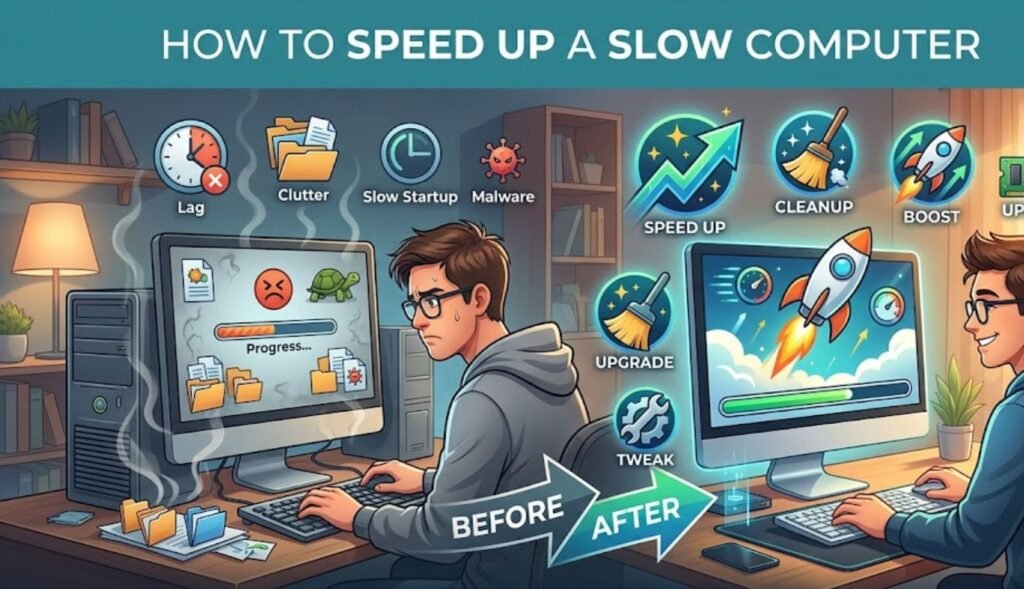
If you’ve ever wondered how to speed up a slow computer, you’re certainly not alone. A slow computer can make even the simplest tasks feel frustrating. Whether you’re browsing the internet, editing documents, attending online meetings, or playing games, poor performance wastes valuable time and reduces productivity.
Fortunately, you don’t always need to buy a brand-new computer. In many cases, simple maintenance and a few smart upgrades can dramatically improve your PC’s speed. This guide explains practical and proven methods that work for Windows computers of all ages.
By following these optimization techniques, you’ll notice:
- Faster startup times
- Quicker application launches
- Improved multitasking
- Better gaming performance
- Smoother web browsing
- Increased system stability
- Longer hardware lifespan
Let’s begin by understanding why computers slow down over time.
Comprehensive Outline
| Heading Level | Topic | Description |
|---|---|---|
| H1 | How to Speed Up a Slow Computer: 15 Powerful Ways to Boost Performance Fast | Main article title |
| H2 | Introduction | Importance of computer performance |
| H2 | Why Computers Become Slow | Common reasons behind sluggish performance |
| H3 | Too Many Startup Programs | Startup overload |
| H3 | Low Storage Space | Storage limitations |
| H3 | Malware and Viruses | Security threats |
| H3 | Outdated Software | Software compatibility |
| H2 | Method 1: Disable Startup Programs | Improve boot time |
| H2 | Method 2: Uninstall Unnecessary Applications | Remove software clutter |
| H2 | Method 3: Free Up Disk Space | Clean storage |
| H3 | Delete Temporary Files | Temporary data removal |
| H3 | Empty Recycle Bin | Recover storage |
| H2 | Method 4: Update Windows and Drivers | Improve compatibility |
| H2 | Method 5: Scan for Malware | Remove harmful programs |
| H2 | Benefits of Regular Computer Maintenance | Long-term optimization |
| H2 | Frequently Asked Questions | Common user queries |
| H2 | Conclusion | Final recommendations |
Why Computers Become Slow
Every computer gradually loses performance after months or years of use. This doesn’t necessarily mean your hardware is failing. Instead, everyday usage creates clutter that affects speed.
Several factors contribute to sluggish performance.
Too Many Startup Programs
Many applications automatically configure themselves to launch every time Windows starts.
Examples include:
- Cloud storage apps
- Chat software
- Printer utilities
- Game launchers
- Music streaming services
Although each program uses only a small amount of memory, together they can significantly delay boot time.
Signs include:
- Windows takes several minutes to load
- Desktop icons appear slowly
- Programs become responsive only after several minutes
Reducing startup applications is one of the quickest ways to improve performance.
Low Storage Space
Storage plays a much bigger role than many people realize.
When your primary drive becomes nearly full, Windows struggles to manage temporary files and virtual memory efficiently.
Common causes include:
- Large video files
- Duplicate photos
- Downloaded installers
- Old games
- Unused software
- Temporary browser files
Experts recommend keeping at least 15–20% of your storage drive free for optimal performance.
Malware and Viruses
Malicious software doesn’t just threaten your privacy—it also slows your computer.
Malware often runs silently in the background, consuming:
- CPU resources
- RAM
- Internet bandwidth
- Storage space
Typical warning signs include:
- Unexpected advertisements
- Browser redirects
- Unknown applications
- High CPU usage
- Constant fan noise
- Frequent crashes
Running regular security scans is essential for maintaining peak performance.
Outdated Software
Older software versions may contain:
- Performance bugs
- Memory leaks
- Compatibility problems
- Security vulnerabilities
Keeping Windows, drivers, and applications updated ensures your system benefits from the latest performance improvements.
Method 1: Disable Startup Programs
One of the easiest answers to how to speed up a slow computer is reducing startup applications.
Every unnecessary startup program increases boot time and consumes system memory before you even begin working.
How to Disable Startup Programs
Follow these simple steps:
- Press Ctrl + Shift + Esc.
- Open Task Manager.
- Select the Startup tab.
- Review all enabled applications.
- Disable programs you don’t need immediately after startup.
Good candidates include:
- Spotify
- Discord
- Skype
- Adobe Updater
- Game launchers
- Microsoft Teams (if not used daily)
Avoid disabling:
- Antivirus software
- Audio drivers
- Graphics drivers
- Touchpad software
- Windows services
Benefits
Disabling unnecessary startup apps provides several advantages:
| Before | After |
|---|---|
| Slow boot | Faster startup |
| High RAM usage | More available memory |
| Background clutter | Cleaner desktop |
| Delayed responsiveness | Immediate usability |
Most users notice improvements after the very next reboot.
Method 2: Uninstall Unnecessary Applications
Many computers contain dozens of programs that haven’t been opened in months—or even years.
Unused applications consume:
- Disk space
- Background services
- Scheduled tasks
- Automatic updates
Removing them helps Windows operate more efficiently.
How to Remove Programs
Open:
Settings → Apps → Installed Apps
or
Control Panel → Programs and Features
Sort by:
- Size
- Installation date
- Last used
Remove applications you no longer need.
Examples include:
- Trial software
- Old games
- Toolbars
- Duplicate utilities
- Manufacturer bloatware
Always verify that a program isn’t required by your hardware before uninstalling it.
Advantages
Removing unused software offers several benefits:
- Faster startup
- More free storage
- Reduced background activity
- Improved system responsiveness
- Fewer software conflicts
Method 3: Free Up Disk Space
A cluttered hard drive slows file access and affects overall system performance.
Cleaning unnecessary files is one of the safest maintenance tasks you can perform.
Delete Temporary Files
Windows creates temporary files whenever you:
- Browse websites
- Install software
- Update Windows
- Edit documents
Over time, these files can consume several gigabytes.
To clean them:
- Press Windows + R.
- Type:
tempDelete everything you can.
Next, repeat using:
%temp%Finally:
prefetchWindows may prevent deletion of files currently in use. That’s perfectly normal.
Empty the Recycle Bin
Many users forget that deleted files remain in the Recycle Bin until it’s emptied.
Large videos and software installers can occupy dozens of gigabytes.
To empty it:
- Right-click Recycle Bin.
- Select Empty Recycle Bin.
- Confirm deletion.
Use Storage Sense
Windows includes a built-in feature called Storage Sense that automatically removes unnecessary files.
It can clean:
- Temporary files
- Windows Update leftovers
- Downloads (optional)
- Recycle Bin contents
- Cloud cache
Enable Storage Sense through:
Settings → System → Storage
This automatic cleanup helps maintain your computer without requiring manual intervention.
Method 4: Update Windows and Device Drivers
Keeping your operating system and hardware drivers up to date is one of the most effective ways to maintain a fast and secure computer. Microsoft and hardware manufacturers frequently release updates that improve performance, fix bugs, and patch security vulnerabilities.
Why Updates Matter
Updated software can:
- Improve system stability
- Enhance hardware compatibility
- Fix performance-related bugs
- Reduce crashes and freezing
- Strengthen security against new threats
Outdated drivers, especially for graphics cards, network adapters, and storage devices, can cause slow performance and unexpected errors.
How to Update Windows
Follow these steps:
- Open Settings.
- Select Windows Update.
- Click Check for Updates.
- Download and install available updates.
- Restart your computer if prompted.
It’s a good idea to check for updates at least once a month.
Update Device Drivers
Windows installs many drivers automatically, but manufacturers often provide newer versions with better performance.
Drivers you should keep updated include:
- Graphics card
- Chipset
- Network adapter
- Bluetooth
- Audio device
- SSD firmware
Visit your computer manufacturer’s support page or the hardware manufacturer’s website to download the latest drivers.
Method 5: Scan for Malware and Viruses
Malware is a common reason behind poor computer performance. Harmful software can run silently in the background, consuming system resources and slowing down your PC.
Signs of Malware Infection
Watch for these warning signs:
- Frequent pop-up advertisements
- Browser redirects
- Unknown applications
- High CPU usage
- Slow internet connection
- Unexpected crashes
- Disabled antivirus software
Perform a Full Security Scan
Windows includes built-in protection through Microsoft Defender.
To run a scan:
- Open Windows Security.
- Select Virus & Threat Protection.
- Click Scan Options.
- Choose Full Scan.
- Start the scan.
If malware is detected, follow the recommended removal steps and restart your computer.
Best Practices
- Download software only from trusted websites.
- Avoid opening suspicious email attachments.
- Keep antivirus software updated.
- Enable real-time protection.
A clean computer performs significantly better than one infected with malicious software.
Method 6: Upgrade from an HDD to an SSD
If your computer still uses a traditional Hard Disk Drive (HDD), upgrading to a Solid-State Drive (SSD) can provide one of the biggest performance improvements.
HDD vs. SSD
| Feature | HDD | SSD |
|---|---|---|
| Speed | Slower | Much faster |
| Noise | Audible | Silent |
| Durability | Mechanical parts | No moving parts |
| Boot Time | 60–120 seconds | 10–20 seconds |
| File Access | Slower | Almost instant |
Benefits of an SSD
After upgrading, you’ll likely notice:
- Faster Windows startup
- Quicker application launches
- Reduced loading times
- Improved file transfers
- Better multitasking
Although SSDs cost more than HDDs, they offer excellent value for anyone looking to extend the life of an older computer.
Method 7: Add More RAM
Random Access Memory (RAM) allows your computer to handle multiple tasks at once. If you frequently switch between programs or open many browser tabs, additional RAM can make a noticeable difference.
Signs You Need More RAM
You may benefit from an upgrade if:
- Programs take a long time to open.
- The computer freezes while multitasking.
- Web browsers become sluggish with multiple tabs.
- Video editing or gaming performance is poor.
Recommended RAM Capacity
| Usage | Recommended RAM |
|---|---|
| Basic tasks | 8 GB |
| Office work | 16 GB |
| Gaming | 16–32 GB |
| Professional editing | 32 GB or more |
Before purchasing new RAM, confirm your motherboard supports the desired capacity and speed.
Method 8: Optimize Your Web Browser
A slow browser can make your entire computer feel sluggish, especially if you spend much of your time online.
Common Causes
Browser performance often suffers due to:
- Too many extensions
- Large cache files
- Excessive open tabs
- Outdated browser versions
- Heavy websites
Improve Browser Speed
Try these optimization tips:
- Remove unused extensions.
- Clear browsing cache and cookies.
- Close unnecessary tabs.
- Update your browser regularly.
- Restart the browser occasionally.
Most modern browsers also include a built-in task manager that helps identify tabs or extensions consuming excessive resources.
Method 9: Adjust Visual Effects
Windows includes visual animations and transparency effects that enhance appearance but consume system resources.
Reducing these effects can improve responsiveness, especially on older computers.
Change Performance Settings
- Search for Advanced System Settings.
- Open Performance Settings.
- Select Adjust for Best Performance.
Alternatively, customize the settings to keep only the visual effects you prefer.
Benefits
- Faster window animations
- Reduced CPU usage
- Lower memory consumption
- Improved responsiveness
While the interface may appear simpler, many users appreciate the extra speed.
Method 10: Choose the Right Power Plan
Your computer’s power settings affect how hardware components perform.
Many laptops use balanced or power-saving modes to extend battery life, which can reduce processing speed.
Switch to High Performance
- Open Control Panel.
- Select Power Options.
- Choose High Performance if available.
For laptops, remember that higher-performance modes may reduce battery life. When unplugged, consider switching back to a balanced plan if longer battery runtime is a priority.
Additional Maintenance Tips
Besides the methods above, regular maintenance helps keep your computer running smoothly over time.
Restart Your Computer Regularly
Restarting clears temporary memory, closes unnecessary background processes, and installs pending updates.
Keep Your Desktop Organized
A desktop filled with hundreds of files and shortcuts can make it harder to find what you need and may slightly affect startup times.
Remove Duplicate Files
Duplicate photos, videos, and documents consume valuable storage space. Reviewing and deleting unnecessary duplicates can free up room for your operating system and applications.
Monitor Background Processes
Use Task Manager to identify applications consuming high CPU, memory, or disk resources. If an app is consistently using excessive resources without a clear purpose, consider closing it or uninstalling it.
Back Up Important Data
Regular backups protect your files against hardware failure, accidental deletion, or malware. Keeping backups also makes it easier to perform major system maintenance without worrying about data loss.
Benefits of Regular Computer Maintenance
Routine maintenance offers several long-term advantages:
- Faster overall performance
- Shorter boot times
- Improved system stability
- Better multitasking
- Enhanced security
- Longer hardware lifespan
- Reduced risk of data loss
Spending a few minutes each month on maintenance can help prevent many common performance issues before they become serious.
Method 11: Defragment Your Hard Drive (HDD Only)
If your computer uses a traditional Hard Disk Drive (HDD), regular defragmentation can improve file access speed by reorganizing fragmented data.
Note: Do not manually defragment a Solid-State Drive (SSD). Windows automatically optimizes SSDs differently.
How to Defragment an HDD
- Open the Windows search bar.
- Type Defragment and Optimize Drives.
- Select your HDD.
- Click Optimize.
- Wait for the process to finish.
Benefits
- Faster file access
- Improved application loading times
- Better overall responsiveness
- Reduced disk fragmentation
Method 12: Manage Background Applications
Many applications continue running in the background even after you’ve closed them. These processes consume CPU, memory, and storage resources.
Disable Unnecessary Background Apps
- Open Settings.
- Navigate to Apps.
- Review installed applications.
- Disable unnecessary background permissions where available.
You can also use Task Manager to identify programs using excessive resources and close those that aren’t needed.
Apps That Often Run in the Background
- Messaging apps
- Music streaming services
- Cloud synchronization tools
- Software updaters
- Gaming launchers
Limiting background activity frees system resources for the tasks you actually care about.
Method 13: Clean Your Computer’s Hardware
Software optimization is important, but physical maintenance also plays a major role in performance.
Dust buildup can block airflow, causing your computer to overheat. When temperatures rise, the processor may reduce its speed to prevent damage.
Cleaning Tips
- Turn off and unplug your computer.
- Use compressed air to remove dust from vents and fans.
- Clean filters if your desktop case includes them.
- Ensure all air vents remain unobstructed.
- Keep your computer in a cool, well-ventilated location.
Signs of Overheating
- Loud fan noise
- Unexpected shutdowns
- Reduced performance during demanding tasks
- Excessive heat from the laptop or desktop case
Cleaning your system every few months can help maintain stable performance and extend hardware life.
Method 14: Reset or Reinstall Windows
If you’ve tried every optimization method and your computer is still slow, resetting or reinstalling Windows may be the most effective solution.
Over time, operating systems accumulate outdated settings, unused files, and software conflicts.
Before Resetting
Always back up your:
- Documents
- Photos
- Videos
- Browser bookmarks
- Passwords
- Important project files
Reset Options
Windows offers two choices:
- Keep My Files – Reinstalls Windows while preserving personal files.
- Remove Everything – Performs a clean installation and removes all data.
A fresh installation often restores your computer’s original performance.
Method 15: Upgrade Older Hardware
Sometimes, software optimization alone isn’t enough. If your computer is several years old, upgrading key components can significantly improve performance.
Recommended Hardware Upgrades
| Component | Benefit |
|---|---|
| SSD | Faster boot and load times |
| RAM | Better multitasking |
| CPU (if supported) | Improved processing speed |
| Graphics Card | Better gaming and creative performance |
| Cooling System | Lower temperatures and improved stability |
Not every computer supports every upgrade, so check your manufacturer’s specifications before purchasing new hardware.
Advanced Performance Optimization Tips
If you’re comfortable making deeper system adjustments, these techniques can help fine-tune your PC.
Disable Unnecessary Services
Windows runs numerous services in the background. Some are essential, while others may not be needed depending on how you use your computer.
Research any service carefully before disabling it to avoid affecting system stability.
Monitor System Performance
Use built-in tools such as:
- Task Manager
- Resource Monitor
- Performance Monitor
These utilities help identify which processes are consuming the most CPU, memory, disk, or network resources.
Keep Software Updated
Regularly update:
- Windows
- Device drivers
- Web browsers
- Productivity software
- Security applications
Updates often include performance improvements and security patches.
Common Mistakes to Avoid
While learning how to speed up a slow computer, avoid these common errors:
- Installing multiple antivirus programs at the same time.
- Downloading software from untrusted websites.
- Ignoring Windows updates for long periods.
- Filling your storage drive to maximum capacity.
- Disabling essential Windows services without understanding their purpose.
- Forgetting to back up important files before major changes.
- Leaving dozens of browser tabs open continuously.
Avoiding these mistakes helps maintain a fast and reliable system.
Expert Tips for Long-Term Performance
Follow these habits to keep your computer running smoothly:
- Restart your PC every few days.
- Keep at least 15–20% of your storage drive free.
- Remove programs you no longer use.
- Organize your files into folders.
- Perform monthly malware scans.
- Update drivers regularly.
- Clean dust from your computer every few months.
- Back up important files routinely.
- Use strong passwords and keep your security software active.
Small maintenance tasks performed consistently can prevent many performance issues before they become noticeable.
Frequently Asked Questions (FAQs)
1. Why is my computer so slow even after restarting?
A restart clears temporary memory, but persistent issues such as low storage, outdated drivers, malware, or aging hardware may still affect performance. Review the optimization methods in this guide to identify the underlying cause.
2. Does adding more RAM always make a computer faster?
Additional RAM improves performance when your computer frequently runs out of memory during multitasking. However, if your system already has sufficient RAM, upgrading to an SSD may provide a more noticeable speed improvement.
3. How often should I clean temporary files?
Cleaning temporary files once a month is a good practice. If you install or uninstall software frequently, you may benefit from doing it more often.
4. Is it safe to disable startup programs?
Yes, provided you only disable non-essential applications. Avoid disabling security software, device drivers, or important Windows services.
5. Can malware really slow down my computer?
Yes. Malware often runs hidden processes that consume CPU, memory, storage, and internet bandwidth, leading to poor performance and instability.
6. What’s the biggest upgrade for an older PC?
For most older computers that still use an HDD, replacing it with an SSD delivers the most dramatic improvement in boot time, application loading, and overall responsiveness.
Additional Resources
For official Windows maintenance guidance and troubleshooting, visit the Microsoft Support website:
This resource includes up-to-date instructions for Windows updates, storage management, security, and performance optimization.
Conclusion
Learning how to speed up a slow computer doesn’t have to be difficult or expensive. In many cases, simple maintenance tasks—such as disabling unnecessary startup programs, freeing disk space, updating Windows, removing malware, and cleaning temporary files—can dramatically improve your computer’s performance.
If your system is still slow after applying these techniques, consider hardware upgrades like installing an SSD or adding more RAM. These improvements often provide the greatest performance gains and can extend the useful life of your computer for years.
The key to maintaining a fast PC is consistency. By following the maintenance habits outlined in this guide, you’ll enjoy quicker startup times, smoother multitasking, improved security, and a more reliable computing experience.
Thank you for reading this comprehensive guide. We hope it helps you optimize your computer and get the best possible performance from your Windows system.