


Before You Start
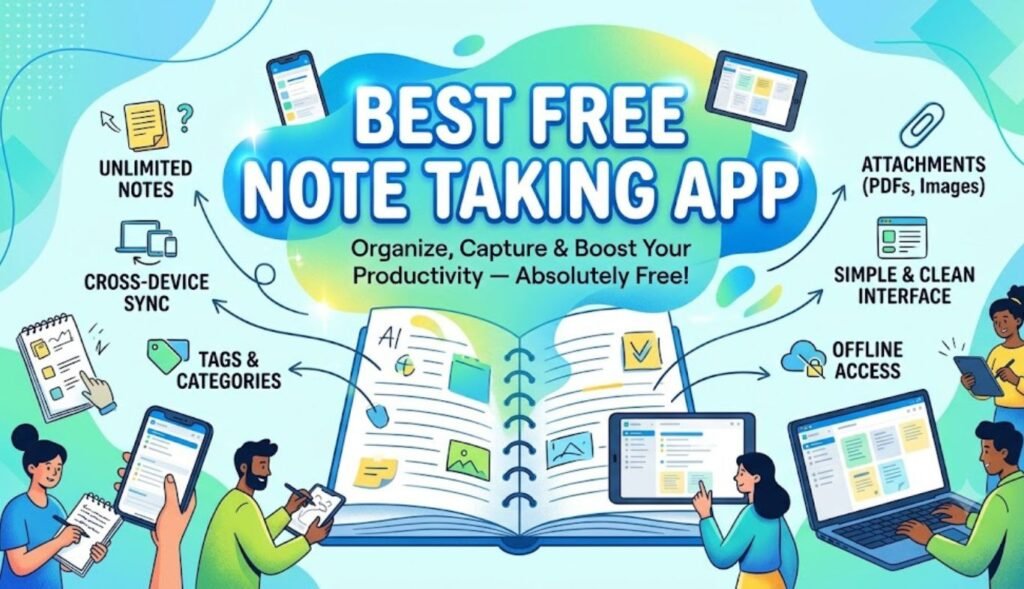
Finding the best free note taking app can completely change the way you organize ideas, manage tasks, and remember important information. Whether you’re a student, freelancer, business owner, or remote worker, choosing the right app saves time and keeps your notes accessible across devices.
In this guide, you’ll discover the best free note-taking apps, their features, strengths, limitations, and how to choose the one that matches your workflow.
Comprehensive Article Outline
| Heading Level | Topic |
|---|---|
| H1 | Best Free Note Taking App: The Ultimate 12 Picks for Better Productivity |
| H2 | Why a Note Taking App Matters Today |
| H2 | What Makes the Best Free Note Taking App |
| H2 | Essential Features to Look For |
| H2 | Best Free Note Taking App for Students |
| H2 | Best Free Note Taking App for Professionals |
| H2 | Best Free Note Taking App for Teams |
| H2 | Cloud Synchronization Explained |
| H2 | Security and Privacy Features |
| H2 | Offline vs Online Note Taking |
| H2 | Organizing Notes Efficiently |
| H2 | Common Mistakes to Avoid |
| H2 | Tips for Better Digital Note Taking |
| H2 | Frequently Asked Questions |
| H2 | Final Thoughts |
| H2 | Conclusion |
Why a Note Taking App Matters Today
Technology has transformed how people collect, organize, and access information. Instead of carrying notebooks everywhere, users can now save ideas instantly using smartphones, tablets, or computers.
The best free note taking app allows users to capture information in seconds. From lecture notes and business meetings to shopping lists and creative writing, digital notes help reduce clutter while improving efficiency.
Modern note-taking applications are much more than digital notebooks. They include collaboration tools, reminders, cloud storage, formatting options, multimedia support, and intelligent search capabilities.
Today’s users expect an app to synchronize seamlessly across multiple devices. Whether you’re using Windows, macOS, Android, iPhone, or Linux, your notes should always be available when needed.
Another important reason people prefer digital note-taking is organization. Unlike paper notebooks, digital apps let users categorize information using:
- Folders
- Tags
- Labels
- Colors
- Notebooks
- Search filters
These features make retrieving information much faster.
Digital note-taking also improves collaboration. Team members can edit shared documents simultaneously, making project management easier than ever.
For students, note-taking apps simplify lecture organization. Professionals use them to document meetings, track projects, and save research. Writers collect ideas instantly before inspiration disappears.
As artificial intelligence continues evolving, many note-taking applications now include smart suggestions, transcription tools, handwriting recognition, and automatic organization.
This makes choosing the right application increasingly important.
What Makes the Best Free Note Taking App?
Not every free application delivers the same experience. Some focus on simplicity, while others provide advanced productivity tools.
The best free note taking app combines ease of use with powerful features that support everyday productivity.
Several factors separate an average app from an excellent one.
Easy User Interface
A clean interface helps users concentrate on writing instead of learning complicated menus.
Simple navigation reduces distractions and encourages consistent note-taking habits.
Cross-Platform Compatibility
Users often switch between multiple devices during the day.
A quality app should support:
| Device | Availability |
|---|---|
| Windows | Yes |
| macOS | Yes |
| Android | Yes |
| iPhone | Yes |
| Web Browser | Yes |
Synchronization across platforms ensures your notes remain updated everywhere.
Fast Search
Finding information quickly saves valuable time.
Modern note-taking apps offer:
- Keyword search
- OCR search for scanned documents
- Tag filtering
- Folder search
- Date filtering
These tools become increasingly valuable as your collection grows.
Rich Formatting
Basic text editing isn’t enough for many users.
The best applications support:
- Headings
- Checklists
- Tables
- Images
- Videos
- PDFs
- Code blocks
- Hyperlinks
Rich formatting keeps notes organized and visually appealing.
Collaboration
Remote work has increased the need for collaborative note-taking.
Many applications now allow users to:
- Share notebooks
- Leave comments
- Edit simultaneously
- Track revisions
These capabilities improve teamwork significantly.
Free Storage
Storage limits vary widely.
Some apps provide generous free cloud storage, while others require paid upgrades for larger files.
Choosing an app with sufficient free storage prevents unnecessary subscription costs.
Offline Access
Internet connections aren’t always available.
Offline functionality allows users to continue writing and automatically synchronize later.
This feature is particularly useful during travel or unreliable network conditions.
Essential Features to Look For
Before selecting any application, understand which features matter most for your workflow.
Below are the essential capabilities every high-quality free note-taking app should provide.
Cloud Backup
Automatic backups protect your information against device failure.
Cloud synchronization ensures your notes remain safe even if your phone or computer is lost.
Multimedia Support
Modern note-taking goes beyond plain text.
Look for applications that support:
- Voice recordings
- Images
- Videos
- PDF attachments
- Drawings
- Handwriting
These options make notes more comprehensive.
Organization Tools
Large collections become difficult to manage without proper organization.
Useful tools include:
- Nested folders
- Tags
- Labels
- Favorites
- Smart filters
Good organization reduces time spent searching.
Reminders
Many productivity apps combine note-taking with reminders.
Users can schedule alerts for:
- Meetings
- Assignments
- Shopping
- Deadlines
This transforms notes into actionable tasks.
Collaboration
Shared workspaces simplify teamwork.
Students can share lecture notes while businesses coordinate project documentation.
Security
Data protection should never be overlooked.
Look for apps offering:
- Password protection
- Encryption
- Two-factor authentication
- Secure cloud storage
Sensitive information deserves strong protection.
Customization
Everyone has different productivity preferences.
Useful customization options include:
- Dark mode
- Themes
- Font sizes
- Notebook colors
- Templates
Personalization creates a more enjoyable user experience.
Best Free Note Taking App for Students
Students require more than simple text editors.
They need applications capable of organizing multiple subjects, lecture notes, assignments, research, and revision materials.
An excellent student note-taking application should provide:
| Feature | Importance |
|---|---|
| Cloud Sync | High |
| PDF Support | High |
| Search | High |
| Organization | High |
| Mobile Access | High |
| Offline Editing | High |
Students often switch between laptops, tablets, and smartphones throughout the day.
Synchronization ensures classroom notes appear instantly across every device.
Another valuable feature is handwriting support. Tablet users frequently prefer handwritten lecture notes combined with typed text and images.
Search functionality also saves enormous amounts of study time. Instead of flipping through hundreds of notebook pages, students simply search a keyword.
Organization remains equally important.
Creating notebooks by:
- Subject
- Semester
- Professor
- Project
- Exam
helps keep academic work structured.
Many free applications also integrate task management, enabling students to track homework, deadlines, and revision schedules in one place.
Collaboration tools further improve learning by allowing classmates to share lecture summaries and project notes.
When selecting the best free note taking app, students should prioritize simplicity, speed, synchronization, and long-term reliability over unnecessary advanced features.
Best Free Note Taking App for Professionals
Professionals need more than a place to jot down ideas. They require a note-taking solution that helps manage meetings, projects, client information, and daily tasks. The best free note taking app for professionals should streamline workflows while keeping information secure and easy to access.
One of the biggest advantages of digital note-taking is the ability to organize work across multiple devices. Whether you’re attending a meeting with a laptop or reviewing notes on your smartphone, synchronized content keeps you productive.
Features Professionals Should Prioritize
| Feature | Why It Matters |
|---|---|
| Cross-device sync | Access notes from anywhere |
| Rich text editing | Create structured meeting notes |
| Task integration | Track action items |
| Calendar integration | Stay on schedule |
| File attachments | Store documents with notes |
| Search function | Find information instantly |
Professionals also benefit from templates for meeting agendas, project plans, and client records. Instead of creating documents from scratch, templates save valuable time and ensure consistency.
Another useful capability is note sharing. Team members can collaborate on meeting minutes, brainstorm ideas, or update project documentation in real time.
Best Free Note Taking App for Teams
Collaboration has become a standard part of modern workplaces. Teams often work across different locations and time zones, making cloud-based note-taking essential.
The ideal free app for teams supports shared workspaces where everyone can contribute without confusion.
Benefits of Collaborative Notes
- Share meeting agendas before discussions.
- Assign tasks directly within notes.
- Track edits and revisions.
- Keep project documentation centralized.
- Reduce duplicate files.
Version history is another valuable feature. If someone accidentally deletes information, previous versions can often be restored.
Permission controls also improve security by allowing administrators to decide who can view, edit, or comment on shared notebooks.
Communication becomes much smoother when everyone works from the same information instead of exchanging multiple document versions through email.
Cloud Synchronization Explained
Cloud synchronization is one of the most valuable features offered by modern note-taking applications.
Whenever you update a note, the changes are uploaded to secure cloud servers. Those updates then appear automatically on your other devices.
For example, imagine writing lecture notes on your tablet during class. By the time you open your laptop at home, those notes are already available without manually transferring files.
Advantages of Cloud Sync
| Benefit | Description |
|---|---|
| Automatic backup | Protects notes from device loss |
| Multi-device access | Work from phone, tablet, or PC |
| Real-time updates | Changes appear instantly |
| Easy collaboration | Share notebooks with others |
| Reduced data loss | Keeps copies securely stored |
Cloud synchronization also minimizes the risk of losing important information due to hardware failures.
However, users should ensure their chosen app uses encrypted connections and secure cloud storage to protect sensitive data.
Security and Privacy Features
Security should always be considered when selecting a note-taking application.
Personal journals, financial records, passwords, meeting notes, and business plans often contain confidential information.
The best free note taking app should provide strong security features without sacrificing convenience.
Important Security Features
- Password protection
- End-to-end encryption (where available)
- Two-factor authentication
- Secure cloud storage
- Biometric login
- Automatic backups
Encryption ensures that even if data is intercepted, it cannot easily be read without the proper encryption keys.
Many applications also support fingerprint or facial recognition on mobile devices, providing quick yet secure access.
Businesses should pay close attention to compliance requirements if storing sensitive customer information.
Offline vs Online Note Taking
One common question users ask is whether offline or online note-taking is better.
The answer depends on how and where you work.
Offline Note Taking
Offline editing allows users to continue writing without an internet connection.
Benefits include:
- Works during travel.
- Faster editing.
- No dependence on Wi-Fi.
- Better privacy in some situations.
Once the device reconnects to the internet, notes synchronize automatically.
Online Note Taking
Online note-taking provides several advantages.
These include:
- Instant cloud backup
- Live collaboration
- Real-time synchronization
- Access from multiple devices
For many users, a hybrid solution that supports both offline editing and online synchronization offers the best experience.
Organizing Notes Efficiently
Even the best application becomes difficult to use if notes are poorly organized.
Developing a consistent organizational system saves time and improves productivity.
Create Separate Notebooks
Organize notes by category.
Examples include:
- Work
- Personal
- School
- Projects
- Finance
- Travel
Keeping different topics separate reduces clutter.
Use Tags
Tags allow notes to appear under multiple categories without duplication.
Examples:
- Meeting
- Research
- Important
- Urgent
- Ideas
Tags are especially useful when searching large note collections.
Use Clear Titles
Avoid vague names like:
- Notes
- New Document
- Ideas
Instead, create descriptive titles such as:
- Marketing Strategy Meeting July 2026
- Biology Chapter 5 Summary
- Weekly Budget Planning
Clear titles make searching much easier.
Archive Old Notes
Completed projects don’t need to remain in active folders.
Archiving keeps your workspace clean while preserving valuable information.
Common Mistakes to Avoid
Many users don’t get the most from their note-taking apps because of poor habits rather than poor software.
Avoid these common mistakes.
Keeping Everything in One Notebook
Large collections quickly become difficult to navigate.
Instead, organize notes into logical categories.
Forgetting Backups
Even cloud services can experience problems.
Export important notebooks occasionally for additional protection.
Ignoring Tags
Tags significantly improve search results.
Skipping them often leads to wasted time looking for information.
Writing Unclear Titles
Specific titles make future searches far easier.
A few extra seconds spent naming notes properly saves hours later.
Choosing Features You Never Use
Some people select overly complex software packed with advanced tools they never need.
Instead, focus on applications that match your workflow and daily habits.
Tips for Better Digital Note Taking
Choosing the best free note taking app is only the first step. Developing effective note-taking habits will help you capture ideas, organize information, and retrieve it quickly when needed. Whether you’re a student, professional, or casual user, these practical tips can improve your productivity.
Keep Notes Organized
Create notebooks or folders for different areas of your life, such as work, education, personal projects, and finances. This structure makes it easier to locate information later.
Use Tags and Keywords
Tags help categorize notes across multiple topics. For example, a project meeting note could include tags like Project, Meeting, and Important. Using consistent keywords also improves search results.
Review Notes Regularly
Set aside a few minutes each week to review your notes. Archive outdated information, update ongoing projects, and delete duplicates. Regular maintenance keeps your workspace clean and useful.
Add Images and Files
Many note-taking apps allow you to attach images, PDFs, and voice recordings. These additions provide context and make your notes more informative.
Create Checklists
Turn ideas into action by using checklists for daily tasks, shopping lists, or project milestones. Checking off completed items provides a clear sense of progress.
Sync Across Devices
Enable cloud synchronization so your notes are available on your phone, tablet, laptop, and desktop computer. This ensures you always have access to your information when you need it.
Comparison of Popular Free Note-Taking Apps
The table below compares some of the most widely used free note-taking applications.
| App | Best For | Free Plan | Cloud Sync | Offline Access | Collaboration |
|---|---|---|---|---|---|
| Microsoft OneNote | Students & Professionals | Yes | Yes | Yes | Yes |
| Google Keep | Quick Notes | Yes | Yes | Limited | Yes |
| Evernote | Organized Workflows | Limited | Yes | Limited | Yes |
| Notion | Projects & Teams | Yes | Yes | Limited | Yes |
| Obsidian | Personal Knowledge Management | Yes | Optional | Yes | Limited |
| Joplin | Privacy-Focused Users | Yes | Optional | Yes | Limited |
| Simplenote | Minimalist Notes | Yes | Yes | Yes | Limited |
Each application offers unique strengths. Consider your preferred workflow, storage needs, collaboration requirements, and device compatibility before making a decision.
How to Choose the Best Free Note Taking App
With so many options available, selecting the right app can feel overwhelming. Start by identifying your primary use case.
If you need quick reminders and simple lists, a lightweight app may be enough. Students often benefit from apps with notebook organization, PDF support, and handwriting capabilities. Professionals usually require collaboration tools, rich formatting, and secure cloud synchronization.
When evaluating an app, consider the following questions:
- Does it support all of your devices?
- Can you organize notes with folders and tags?
- Is offline editing available?
- Does the free version include enough storage?
- Are your notes protected with strong security features?
- Can you easily export your data if you switch apps later?
Choosing an application that fits your daily routine will help you stay consistent and productive.
Frequently Asked Questions
1. What is the best free note taking app overall?
There is no single app that suits everyone. Microsoft OneNote, Google Keep, Notion, and Obsidian are among the most popular choices because they offer reliable free plans and useful features for different types of users.
2. Which free note-taking app is best for students?
Students generally benefit from apps that provide notebook organization, cloud synchronization, handwriting support, and multimedia attachments. OneNote is a popular option because it combines these features in a free plan.
3. Can I use a free note-taking app offline?
Yes. Many note-taking applications support offline editing. Your notes will automatically synchronize once your device reconnects to the internet.
4. Are free note-taking apps secure?
Most reputable applications use encrypted connections and secure cloud storage. For added protection, choose an app that supports password protection or two-factor authentication.
5. Which app is best for team collaboration?
Notion and Microsoft OneNote offer strong collaboration features, allowing multiple users to edit and share notes in real time.
6. Can I attach files and images to my notes?
Yes. Most modern note-taking apps allow you to add images, PDFs, voice recordings, and other attachments, although storage limits may vary in free plans.
Conclusion
Finding the best free note taking app doesn’t have to be difficult. The ideal choice depends on your personal needs, preferred devices, and daily workflow. Some users prioritize simplicity, while others need advanced collaboration, multimedia support, or powerful organization features.
Free note-taking apps have evolved far beyond digital notebooks. They now offer cloud synchronization, intelligent search, task management, and seamless collaboration that can improve productivity in both personal and professional settings.
Take the time to evaluate the features that matter most to you. Experiment with a few different applications, build a consistent note-taking habit, and choose the one that helps you stay organized over the long term. With the right tool and workflow, you’ll spend less time searching for information and more time putting your ideas into action.