
How to Scan Documents with Phone Like a Pro: 15 Powerful Methods for Perfect Digital Scans
Introduction
Knowing how to scan documents with phone has become an essential skill in today’s digital world. Whether you’re a student submitting assignments, an employee sending contracts, a freelancer sharing invoices, or simply someone organizing personal paperwork, your smartphone can replace a bulky scanner.
Modern smartphones include powerful cameras, artificial intelligence, automatic edge detection, and image enhancement tools that make document scanning easier than ever. Instead of searching for a scanner at home or visiting a print shop, you can create professional-quality digital copies within minutes.
The best part is that most Android and iPhone devices already include built-in scanning features. If you need even more functionality, numerous free apps offer PDF creation, Optical Character Recognition (OCR), cloud synchronization, and document organization.
In this comprehensive guide, you’ll learn how to scan documents with phone efficiently while achieving sharp, readable, and professional-looking results.
Comprehensive Article Outline
| Heading Level | Topic | Description |
|---|---|---|
| H1 | How to Scan Documents with Phone Like a Pro | Main article title |
| H2 | Introduction | Importance of mobile document scanning |
| H2 | What Does It Mean to Scan Documents with a Phone? | Basic overview |
| H2 | Benefits of Using Your Smartphone as a Scanner | Advantages over traditional scanners |
| H2 | What You Need Before You Start | Preparation checklist |
| H2 | How to Scan Documents with Phone on Android | Step-by-step guide |
| H2 | How to Scan Documents with Phone on iPhone | Step-by-step guide |
| H2 | Best Apps to Scan Documents with Phone | Popular scanning applications |
| H2 | How OCR Improves Document Scanning | Understanding Optical Character Recognition |
| H2 | Tips for Getting Crystal Clear Scans | Professional scanning techniques |
| H2 | Common Mistakes to Avoid | Errors users make |
| H2 | Comparing Mobile Scanners vs Traditional Scanners | Comparison table |
| H2 | Advanced Scanning Features | PDF, signatures, cloud storage |
| H2 | Frequently Asked Questions | Six detailed FAQs |
| H2 | Conclusion | Final thoughts |
What Does It Mean to Scan Documents with a Phone?
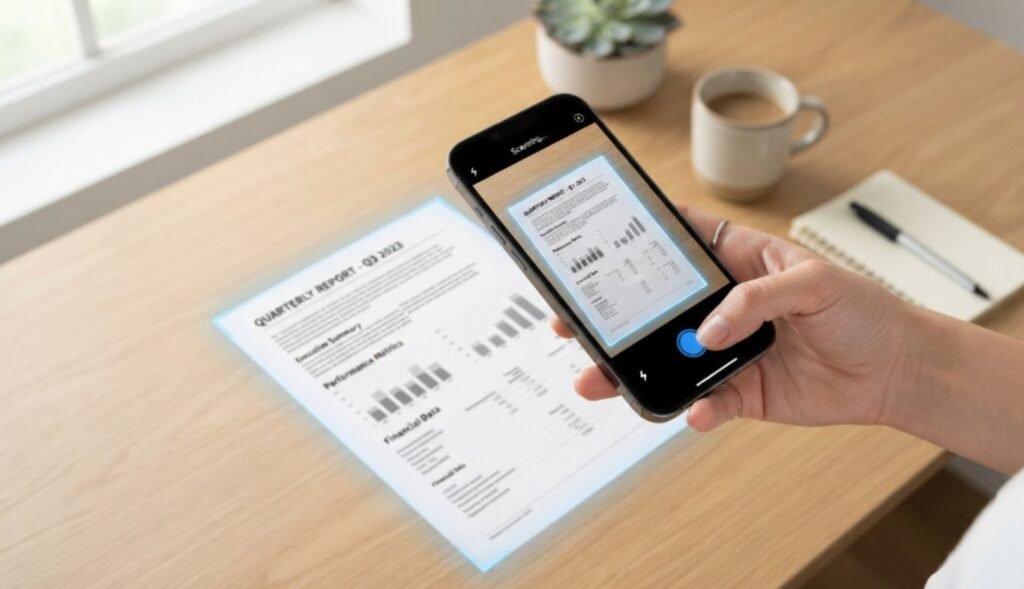
Document scanning with a smartphone means using your phone’s camera to capture a paper document and convert it into a digital file.
Unlike taking an ordinary photograph, document scanning apps automatically:
- Detect document edges
- Correct perspective
- Improve brightness
- Remove shadows
- Increase text clarity
- Convert images into PDFs
- Organize multiple pages into one file
This process creates files that look similar to documents scanned using traditional office scanners.
Examples include:
- Business contracts
- Receipts
- Bills
- School notes
- Certificates
- Legal papers
- Identification documents
- Medical records
Thanks to advancements in artificial intelligence, today’s mobile scanning technology can produce results that rival desktop scanners.
Benefits of Using Your Smartphone as a Scanner
Learning how to scan documents with phone offers many advantages beyond convenience.
1. Saves Time
Instead of connecting hardware or visiting a copy center, you can scan documents instantly.
2. Completely Portable
Your smartphone travels everywhere with you.
That means your scanner is always available whenever you need it.
3. Cost Effective
Traditional scanners cost money and require maintenance.
Your smartphone already has everything necessary.
4. Easy PDF Creation
Most scanning apps automatically create PDF files that are easy to share through email or messaging applications.
5. Cloud Storage Integration
Many scanning tools let you upload files directly to cloud services, helping you access documents from multiple devices.
6. Better Organization
Documents can be organized into folders instead of large filing cabinets.
Searching digital documents is much easier than sorting through paper.
7. OCR Technology
Optical Character Recognition converts printed text into searchable, editable text.
This feature is especially useful for:
- Office workers
- Students
- Researchers
- Business owners
What You Need Before You Start
Before learning how to scan documents with phone, prepare your environment for the best results.
Clean Your Camera Lens
A dirty lens causes blurry scans.
Use a microfiber cloth to remove fingerprints and dust.
Place the Document on a Flat Surface
Avoid wrinkled paper.
Smooth documents produce cleaner scans.
Ensure Good Lighting
Natural daylight works best.
If using indoor lighting:
- Avoid harsh shadows.
- Keep lighting even.
- Don’t point the camera directly at bright lights.
Choose a Plain Background
Dark-colored backgrounds improve automatic edge detection.
Avoid patterned tables or colorful surfaces.
Keep Your Hands Steady
Hold your phone directly above the document.
Tilting the camera may distort the image.
Many apps automatically fix perspective, but starting with a straight shot always improves quality.
How to Scan Documents with Phone on Android
Android phones include several built-in methods for scanning documents.
The exact process depends on your device manufacturer, but the following method works on most modern Android phones.
Method 1: Using Google Drive
Google Drive includes a free document scanner.
Step 1
Open Google Drive.
Step 2
Tap the + button.
Step 3
Select Scan or Scan Document.
Step 4
Point your camera toward the document.
Step 5
Allow the app to automatically detect the page.
Step 6
Capture the image.
Step 7
Crop if necessary.
Step 8
Adjust brightness and contrast.
Step 9
Save as a PDF.
The scanned document is automatically stored in your Google Drive account.
Method 2: Using Google Files
Some Android devices also support document scanning directly through the Files application.
Benefits include:
- Fast scanning
- Automatic edge detection
- PDF export
- Cloud backup
- Easy sharing
Method 3: Using Samsung Camera (Galaxy Phones)
Many Samsung Galaxy devices include built-in document scanning.
Simply:
- Open Camera.
- Point it toward a document.
- Wait for document detection.
- Tap Scan.
- Save the result.
No additional application is required.
How to Scan Documents with Phone on iPhone
Apple has made document scanning incredibly simple through the Notes app.
You don’t need to install extra software.
Step 1
Open the Notes app.
Step 2
Create a new note.
Step 3
Tap the camera icon.
Step 4
Choose Scan Documents.
Step 5
Position your phone over the paper.
The camera automatically detects document edges.
Step 6
Capture the page.
Step 7
Repeat for additional pages.
Step 8
Tap Save.
Your scanned document becomes part of the note.
From there you can:
- Share as PDF
- Store in cloud services
- Edit later
Why Built-in Scanners Are So Popular
Many users never install a third-party scanning app because the built-in options on Android and iPhone are fast, free, and reliable for everyday needs.
Built-in scanners are ideal for:
- Homework
- Office paperwork
- Tax documents
- Receipts
- Medical forms
- Personal records
For more advanced features such as OCR, password-protected PDFs, batch scanning, and electronic signatures, dedicated scanning apps provide additional flexibility and productivity.
Best Apps to Scan Documents with Phone
Although most smartphones have built-in scanning capabilities, dedicated scanning apps offer additional features like Optical Character Recognition (OCR), cloud synchronization, password protection, electronic signatures, and batch scanning.
Below are some of the best document scanning apps available today.
| App | Best For | Free Version | OCR | PDF Export |
|---|---|---|---|---|
| Adobe Scan | Professional document scanning | Yes | Yes | Yes |
| Microsoft Lens | Students and Office users | Yes | Yes | Yes |
| CamScanner | Business documents | Yes | Yes | Yes |
| Genius Scan | Everyday scanning | Yes | Premium | Yes |
| SwiftScan | Cloud integration | Yes | Premium | Yes |
Adobe Scan
Adobe Scan is one of the most trusted mobile scanning apps.
Features include:
- Automatic edge detection
- OCR text recognition
- PDF conversion
- Cloud synchronization
- Image enhancement
- Business card scanning
Best for: Professionals and office users.
Microsoft Lens
Microsoft Lens integrates seamlessly with Microsoft Office applications.
It works especially well for:
- Whiteboards
- Lecture notes
- Receipts
- Contracts
- Presentations
Scanned files can be saved directly into:
- Word
- OneNote
- OneDrive
CamScanner
CamScanner has remained popular for years because of its rich feature set.
Highlights include:
- Batch scanning
- OCR
- Password protection
- Watermark removal (Premium)
- Document sharing
Genius Scan
Genius Scan focuses on simplicity.
Users enjoy:
- Fast scanning
- Smart cropping
- Multi-page PDF creation
- Automatic enhancement
- Folder organization
SwiftScan
SwiftScan is ideal for businesses needing cloud storage integration.
Supported platforms include:
- Dropbox
- Google Drive
- OneDrive
- Evernote
- Box
Understanding OCR (Optical Character Recognition)
One of the biggest advantages of learning how to scan documents with phone is using OCR technology.
OCR stands for Optical Character Recognition.
Instead of creating only an image, OCR identifies printed text and converts it into editable, searchable content.
For example:
A printed invoice becomes searchable.
A textbook page can be copied into a Word document.
Business cards can automatically create contacts.
Benefits of OCR
- Search documents instantly
- Copy text without typing
- Edit scanned pages
- Translate documents
- Improve accessibility
- Reduce manual work
OCR is especially useful for:
- Students
- Teachers
- Lawyers
- Researchers
- Journalists
- Business professionals
Tips for Getting Crystal Clear Scans
Anyone can scan a document, but professional-looking scans require attention to detail.
Here are expert techniques to improve every scan.
1. Use Bright, Even Lighting
Natural daylight provides excellent results.
Avoid:
- Flash reflections
- Dark shadows
- Uneven lighting
2. Keep the Camera Parallel
Hold your phone directly above the paper.
This minimizes distortion and improves automatic cropping.
3. Avoid Wrinkled Documents
Flatten the paper before scanning.
Folded pages often create unwanted shadows.
4. Scan in High Resolution
Higher resolution captures more detail, making small text easier to read.
5. Clean the Camera Lens
Even a small fingerprint can reduce image quality.
Wipe the lens before scanning.
6. Use Automatic Edge Detection
Most scanning apps automatically detect document borders.
Review the crop before saving.
7. Scan Multiple Pages Together
Instead of creating separate files, combine pages into a single PDF.
This keeps documents organized and easier to share.
8. Name Files Clearly
Instead of using names like:
- Scan001.pdf
Use descriptive names such as:
- Tax_Return_2026.pdf
- Employment_Contract.pdf
- Passport_Copy.pdf
This makes future searches much easier.
Advanced Features You Should Use
Modern document scanning apps offer much more than basic image capture.
Automatic Color Correction
AI enhances faded documents while preserving readability.
Shadow Removal
Many apps automatically eliminate dark shadows caused by overhead lighting.
Perspective Correction
If the camera isn’t perfectly aligned, software corrects the document’s angle to produce a flat, professional appearance.
Multi-Page PDF Creation
Ideal for:
- Reports
- Contracts
- Assignments
- Books
- Manuals
Electronic Signatures
Many premium scanning apps let you:
- Sign PDFs
- Request signatures
- Fill forms digitally
This is especially useful for remote work.
Password-Protected PDFs
Protect confidential documents with encryption before sharing.
Suitable for:
- Financial statements
- Medical records
- Legal documents
Cloud Synchronization
Automatic backups prevent document loss.
Popular cloud platforms include:
- Google Drive
- Dropbox
- OneDrive
- iCloud
- Box
Mobile Scanner vs Traditional Scanner
The choice depends on your needs. Here’s a quick comparison.
| Feature | Smartphone Scanner | Traditional Scanner |
|---|---|---|
| Portability | Excellent | Poor |
| Cost | Usually free | Requires hardware purchase |
| Speed | Very fast | Moderate |
| OCR Support | Yes | Yes |
| Multi-page PDF | Yes | Yes |
| Bulk Scanning | Limited | Excellent |
| Cloud Backup | Built-in | Depends on software |
| Convenience | Excellent | Moderate |
| Image Quality | Very good | Excellent |
Which One Should You Choose?
Choose a smartphone scanner if you:
- Travel frequently
- Need quick scans
- Scan occasionally
- Prefer convenience
Choose a traditional scanner if you:
- Scan hundreds of pages daily
- Need archival-quality images
- Work in a high-volume office
- Require specialized scanning for books or photographs
Common Mistakes to Avoid
Even with excellent scanning apps, simple mistakes can reduce document quality.
Poor Lighting
Dark environments create grainy images and make text difficult to read.
Solution: Use bright, even lighting.
Using the Flash
Flash often causes glare, especially on glossy paper.
Solution: Turn off the flash unless absolutely necessary.
Cropping Too Much
Cutting off document edges can remove important information.
Solution: Review the crop before saving.
Moving the Phone
Shaky hands result in blurry scans.
Solution: Hold the phone steady or rest your elbows on a table.
Ignoring File Organization
Hundreds of unnamed scans quickly become difficult to manage.
Solution: Create folders and use descriptive filenames.
Forgetting to Review Before Sharing
Always inspect the final PDF for:
- Missing pages
- Blurred text
- Crooked alignment
- Incorrect orientation
A quick review helps prevent errors and saves time later.
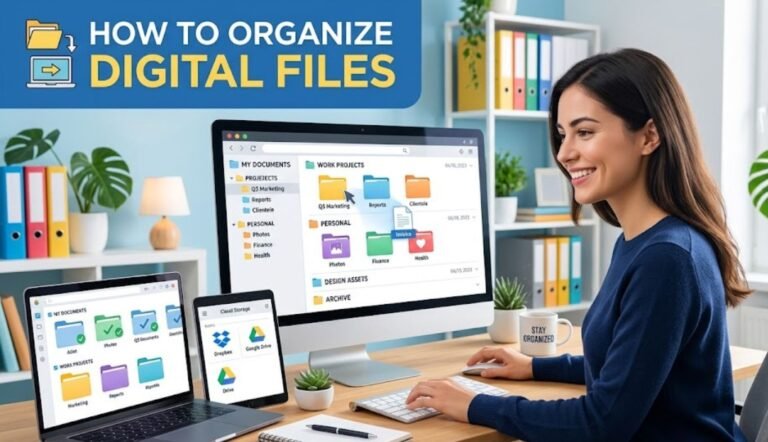
Organizing Your Digital Documents
Scanning documents is only part of the process. Good organization makes them easier to find when you need them.
Consider these best practices:
- Create folders by year or category.
- Use consistent file naming conventions.
- Back up important files to the cloud.
- Archive older documents instead of deleting them immediately.
- Keep sensitive files in password-protected folders when possible.
A well-organized digital filing system can save hours of searching over time.
FAQs
1. How do I scan documents with my phone without an app?
Yes, you can scan documents without installing a separate application.
Most modern smartphones include built-in scanning features.
For example:
- iPhone users can scan documents through the Notes app.
- Android users can use tools like Google Drive’s scanning feature or built-in camera scanning options available on many devices.
These built-in solutions allow you to capture documents, crop pages automatically, improve image quality, and save files as PDFs.
However, dedicated scanning apps may provide extra features such as OCR, password protection, advanced editing, and cloud integration.
2. What is the best app to scan documents with phone?
The best scanning app depends on your needs.
For professional users, Adobe Scan is an excellent choice because it provides OCR, PDF creation, and automatic image enhancement.
For students and Microsoft Office users, Microsoft Lens is a great option because it connects easily with Word, OneNote, and OneDrive.
For users who need advanced document management, CamScanner, Genius Scan, and SwiftScan provide additional productivity features.
When choosing an app, consider:
- OCR support
- PDF quality
- Cloud storage options
- Security features
- Ease of use
- Editing tools
A simple user who only scans occasionally may prefer built-in tools, while businesses may benefit from premium applications.
3. Can I scan a document and convert it into editable text?
Yes.
Many modern scanning applications use Optical Character Recognition (OCR) technology to convert scanned images into editable text.
With OCR, you can:
- Copy text from scanned pages
- Search inside documents
- Edit information
- Translate content
- Export text into Word files
OCR works best when:
- The document has clear printing.
- Lighting is good.
- The camera image is sharp.
- The page is not damaged.
Handwritten documents may produce less accurate results because OCR technology works best with printed text.
4. How can I improve the quality of phone document scans?
To create professional-quality scans, follow these simple tips:
- Clean your phone camera lens.
- Use natural or bright lighting.
- Place documents on a flat surface.
- Hold the phone directly above the page.
- Avoid using flash on shiny paper.
- Use automatic document detection.
- Save files in high resolution.
- Review the final scan before sharing.
Small improvements in your scanning setup can significantly increase document clarity.
5. Are phone scans as good as traditional scanner scans?
For everyday documents, smartphone scans can be almost as good as traditional scanners.
Modern phones use:
- High-resolution cameras
- Artificial intelligence enhancement
- Automatic cropping
- Perspective correction
- Image processing technology
However, traditional scanners still have advantages for professional environments.
A dedicated scanner may be better for:
- Large scanning projects
- Archiving thousands of documents
- High-resolution photography
- Book scanning
For normal tasks like receipts, forms, invoices, and contracts, smartphone scanning is usually more than enough.
6. Can I scan multiple pages into one PDF using my phone?
Yes. Most document scanning applications allow you to combine multiple pages into a single PDF file.
This feature is useful for:
- School assignments
- Business reports
- Legal documents
- Application forms
- Meeting notes
Simply scan each page one after another and select the option to save all pages together.
A multi-page PDF is easier to:
- Share
- Store
- Upload online
7. Is scanning documents with a phone secure?
Yes, but security depends on how you store and share your files.
To protect important documents:
- Use trusted scanning apps.
- Enable device security features.
- Avoid sending sensitive files through unsafe platforms.
- Use password-protected PDFs when possible.
- Store confidential files in secure cloud accounts.
Documents containing private information, such as financial records or identity documents, should receive extra protection.
8. Can I scan documents with my phone offline?
Yes, many scanning apps work without an internet connection.
You can usually:
- Capture documents
- Crop images
- Create PDFs
- Save files locally
Internet access may only be required for features such as:
- Cloud backup
- Online OCR processing
- File sharing
- Synchronization
If you frequently scan while traveling, choose an app that supports offline scanning.
Expert Tips for Better Mobile Document Scanning
Professional-looking scans do not require expensive equipment. A few smart habits can improve your results significantly.
Use a Document Stand
If you frequently scan papers, a phone stand can keep your camera stable and aligned.
Benefits include:
- Less shaking
- Faster scanning
- Better consistency
- Improved accuracy
Scan Important Documents Immediately
Don’t wait until paperwork becomes a problem.
Create digital copies of important items such as:
- Certificates
- Receipts
- Contracts
- Insurance papers
- Educational records
Digital backups provide extra protection against lost or damaged paperwork.
Use File Naming Systems
A good naming system makes documents easier to locate.
Examples:
Instead of:
Document123.pdf
Use:
Car_Insurance_July_2026.pdf
or:
University_Application_Form.pdf
Clear names improve productivity.
Keep Backup Copies
Important documents should never exist in only one location.
Consider keeping copies in:
- Cloud storage
- External drives
- Secure folders
A backup system protects your information from accidental deletion or device damage.
The Future of Mobile Document Scanning
Mobile scanning technology continues to improve.
Future smartphones are expected to offer:
- More accurate AI recognition
- Better text extraction
- Automatic document classification
- Improved security features
- Faster cloud processing
- Smarter organization tools
Artificial intelligence will continue making document management easier.
Soon, phones may automatically recognize document types, rename files, organize folders, and extract important information without manual effort.
Conclusion
Learning how to scan documents with phone is a valuable skill that makes everyday tasks faster, easier, and more organized. With modern smartphone cameras, built-in scanning tools, and powerful document scanning apps, you no longer need expensive equipment to create high-quality digital copies.
Whether you need to scan receipts, contracts, school notes, invoices, certificates, or personal records, your smartphone can handle the job efficiently. By following proper scanning techniques—such as using good lighting, keeping the camera steady, choosing the right app, and organizing your files—you can achieve professional-looking results within seconds.
Mobile document scanning also improves productivity by allowing you to create PDFs, extract text using OCR technology, store files in the cloud, and share documents instantly. These features make smartphones an excellent solution for students, professionals, business owners, and anyone looking to reduce paper clutter.
The key to successful document scanning is not only capturing an image but also managing your digital files properly. Always use clear file names, maintain backups, and protect sensitive documents with security features when necessary.