

Introduction
Managing money doesn’t have to feel overwhelming. Whether you’re saving for a vacation, paying off debt, or simply trying to avoid living paycheck to paycheck, learning how to create a personal budget spreadsheet is one of the smartest financial skills you can develop.
A budget spreadsheet gives you a clear picture of your financial health. Instead of wondering where your money disappears every month, you’ll know exactly how much you earn, spend, save, and invest. Better yet, a well-designed spreadsheet helps you make informed decisions before financial problems arise.
Many people assume budgeting is complicated, but that’s far from the truth. With basic spreadsheet knowledge and a structured plan, anyone can build an effective budgeting system in less than an hour. Once your spreadsheet is ready, updating it only takes a few minutes each week.
Throughout this guide, you’ll discover practical strategies, proven budgeting techniques, and simple formulas that make money management easier than ever.
Comprehensive Outline
| Heading Level | Topic |
|---|---|
| H1 | How to Create a Personal Budget Spreadsheet: Ultimate Guide in 12 Simple Steps |
| H2 | Introduction |
| H2 | What Is a Personal Budget Spreadsheet? |
| H2 | Why Every Household Needs a Budget Spreadsheet |
| H2 | Benefits of Tracking Your Income and Expenses |
| H2 | Choosing the Right Spreadsheet Software |
| H2 | Essential Categories to Include |
| H2 | How to Create a Personal Budget Spreadsheet Step by Step |
| H3 | Step 1: List All Income Sources |
| H3 | Step 2: Record Fixed Expenses |
| H3 | Step 3: Add Variable Expenses |
| H3 | Step 4: Include Savings Goals |
| H3 | Step 5: Track Debt Payments |
| H2 | Adding Formulas to Automate Your Budget |
| H2 | Creating Charts and Graphs |
| H2 | Common Budgeting Mistakes to Avoid |
| H2 | Tips for Maintaining Your Budget Every Month |
| H2 | Free Budget Spreadsheet Templates |
| H2 | Frequently Asked Questions |
| H2 | Conclusion |
What Is a Personal Budget Spreadsheet?
A personal budget spreadsheet is a digital worksheet used to organize your finances. It records your income, expenses, savings, investments, and debt payments in one convenient place.
Instead of relying on memory or paper notes, a spreadsheet automatically calculates totals and helps identify spending habits.
Typical sections include:
| Budget Section | Purpose |
|---|---|
| Income | Monthly earnings |
| Housing | Rent or mortgage |
| Utilities | Electricity, water, internet |
| Transportation | Fuel, insurance, maintenance |
| Food | Groceries and dining |
| Entertainment | Movies, subscriptions, hobbies |
| Savings | Emergency fund and investments |
| Debt | Credit cards and loans |
By organizing financial information into categories, you can quickly identify areas where spending can be reduced.
Why Every Household Needs a Budget Spreadsheet
Financial planning is no longer optional. Rising living costs make it essential to understand where every dollar goes.
Creating a personal budget spreadsheet offers several advantages.
Better Financial Awareness
Many people underestimate their monthly spending. Recording every transaction reveals habits that often go unnoticed.
For example, buying coffee every workday might seem inexpensive. However, over a month, those purchases can total hundreds of dollars.
Improved Savings
When expenses become visible, it’s easier to identify opportunities to save.
Even reducing unnecessary spending by five percent each month can significantly improve your annual savings.
Less Financial Stress
Knowing exactly how much money is available reduces uncertainty.
Instead of worrying about unexpected bills, your spreadsheet helps you prepare in advance.
Easier Goal Setting
Whether you’re saving for a home, college tuition, or retirement, budgeting provides a roadmap for achieving financial goals.
Benefits of Tracking Your Income and Expenses
Understanding cash flow is the foundation of successful money management.
Tracking every dollar provides valuable insights that improve financial decision-making.
Complete Visibility
You’ll always know:
- How much money comes in.
- Where money goes.
- Which expenses are increasing.
- Which categories stay within budget.
Better Spending Habits
Small purchases often add up quickly.
When they’re tracked consistently, people naturally become more mindful of spending decisions.
Accurate Financial Planning
A detailed budget helps estimate future expenses more accurately.
Planning ahead prevents overspending during holidays, vacations, and emergencies.
Faster Debt Repayment
Budget tracking identifies extra money that can be redirected toward loans or credit card balances.
Even modest additional payments can shorten repayment timelines significantly.
Choosing the Right Spreadsheet Software
One of the first decisions you’ll make while learning how to create a personal budget spreadsheet is selecting the right software.
Fortunately, several excellent options are available.
| Software | Best For | Cost |
|---|---|---|
| Microsoft Excel | Advanced budgeting | Paid |
| Google Sheets | Collaboration and cloud access | Free |
| Apple Numbers | Apple users | Free |
| LibreOffice Calc | Offline budgeting | Free |
Microsoft Excel
Excel remains one of the most powerful budgeting tools available.
It offers advanced formulas, pivot tables, conditional formatting, and professional charts.
Ideal for users who want detailed financial reports.
Google Sheets
Google Sheets is perfect for beginners.
Since it’s cloud-based, your budget automatically saves online and can be accessed from almost any device.
It also makes sharing budgets with family members incredibly easy.
Apple Numbers
Apple users appreciate the clean interface and attractive templates available in Numbers.
Its simple layout makes budgeting feel less intimidating.
LibreOffice Calc
If you prefer free desktop software without subscriptions, LibreOffice Calc provides many of Excel’s core features at no cost.
Essential Categories to Include
An effective spreadsheet includes every major financial category.
Missing expenses often create inaccurate budgets.
The most common categories include:
Income
- Salary
- Freelance income
- Business income
- Rental income
- Investment earnings
Fixed Expenses
- Mortgage
- Rent
- Insurance
- Phone
- Internet
- Loan payments
Variable Expenses
- Groceries
- Dining out
- Fuel
- Clothing
- Entertainment
- Medical costs
Savings
- Emergency fund
- Retirement
- Vacation
- Investments
- Education fund
Debt
- Credit cards
- Personal loans
- Student loans
- Car loans
Organizing these categories ensures every dollar has a purpose.
How to Create a Personal Budget Spreadsheet Step by Step
Building your spreadsheet becomes much easier when broken into manageable steps.
Step 1: List All Income Sources
Begin by recording every source of income.
Include:
- Primary salary
- Freelance work
- Side business earnings
- Investment income
- Rental property income
- Government benefits
Add both monthly and annual totals if applicable.
Accuracy is critical because your spending limits depend on your total income.
Step 2: Record Fixed Expenses
Fixed expenses remain relatively unchanged each month.
Examples include:
- Rent
- Mortgage
- Insurance
- Internet
- Mobile phone
- Loan repayments
- Subscription services
Since these expenses are predictable, they form the foundation of your monthly budget.
Step 3: Add Variable Expenses
Unlike fixed expenses, variable expenses change from month to month. These costs depend on your lifestyle, seasonal needs, and unexpected purchases. Tracking them carefully is essential when learning how to create a personal budget spreadsheet because they often provide the greatest opportunity to save money.
Common variable expenses include:
| Expense Category | Examples |
|---|---|
| Groceries | Food, household supplies |
| Transportation | Fuel, parking, public transit |
| Dining Out | Restaurants, coffee shops |
| Entertainment | Movies, streaming services, concerts |
| Shopping | Clothing, gifts, electronics |
| Healthcare | Medicines, doctor visits |
| Personal Care | Haircuts, skincare products |
Review your bank statements from the past three to six months to estimate realistic monthly amounts. This approach helps prevent underestimating your spending.
Tips for Managing Variable Expenses
- Set spending limits for each category.
- Record expenses weekly instead of monthly.
- Keep receipts for better accuracy.
- Review categories regularly and adjust as needed.
- Look for opportunities to reduce unnecessary purchases.
Step 4: Include Savings Goals
A successful budget isn’t just about paying bills—it also helps you build wealth. Every personal budget spreadsheet should include dedicated savings categories.
Examples of savings goals include:
- Emergency fund
- Retirement savings
- Vacation fund
- Home down payment
- Education expenses
- Car replacement fund
- Holiday spending
Why Savings Should Come First
Many financial experts recommend treating savings as a fixed monthly expense. Instead of saving whatever remains at the end of the month, transfer money into your savings account immediately after receiving your income.
This “pay yourself first” strategy helps create consistent financial habits.
Example Savings Table
| Savings Goal | Monthly Contribution | Annual Goal |
|---|---|---|
| Emergency Fund | $300 | $3,600 |
| Vacation | $150 | $1,800 |
| Retirement | $400 | $4,800 |
| Home Down Payment | $500 | $6,000 |
Step 5: Track Debt Payments
Debt management plays a significant role in long-term financial stability. Your spreadsheet should include every outstanding loan and credit balance.
Track:
- Credit cards
- Student loans
- Personal loans
- Auto loans
- Mortgage payments
Include the following information:
| Debt | Balance | Minimum Payment | Interest Rate |
|---|---|---|---|
| Credit Card | $2,500 | $75 | 18% |
| Car Loan | $11,000 | $320 | 5% |
| Student Loan | $15,000 | $180 | 4% |
Monitoring debt in one place makes it easier to prioritize high-interest balances and measure progress over time.
Adding Formulas to Automate Your Budget
One of the greatest advantages of using spreadsheet software is automation. Instead of calculating totals manually, formulas perform the work instantly and reduce errors.
Useful formulas include:
| Formula | Purpose |
|---|---|
SUM() | Adds values in a range |
AVERAGE() | Calculates average spending |
MIN() | Finds the smallest value |
MAX() | Finds the largest expense |
IF() | Creates conditional calculations |
Calculate Total Income
Example:
=SUM(B2:B10)This formula totals all income entries.
Calculate Total Expenses
=SUM(C2:C30)This provides your total monthly spending.
Calculate Remaining Balance
=Total Income - Total ExpensesIf the result is positive, you’re saving money. If it’s negative, your expenses exceed your income and adjustments are needed.
Use Conditional Formatting
Conditional formatting highlights important information automatically.
Examples include:
- Highlight expenses that exceed budget.
- Color savings goals when achieved.
- Flag negative balances.
- Identify overdue debt payments.
These visual cues make your spreadsheet easier to read and maintain.
Creating Charts and Graphs
Visual reports make budgeting more engaging and help identify spending patterns quickly.
Popular chart types include:
Pie Chart
A pie chart shows how each spending category contributes to your overall expenses.
Use it to compare:
- Housing
- Transportation
- Food
- Entertainment
- Savings
Bar Chart
Bar charts compare monthly spending across categories.
They’re ideal for identifying trends over several months.
Line Chart
A line chart displays changes over time.
Track:
- Monthly income
- Savings growth
- Debt reduction
- Overall spending
Sample Monthly Spending Breakdown
| Category | Percentage |
|---|---|
| Housing | 35% |
| Food | 15% |
| Transportation | 12% |
| Utilities | 8% |
| Savings | 15% |
| Entertainment | 5% |
| Miscellaneous | 10% |
Charts provide an easy-to-understand overview of your financial habits and help you make informed decisions.
Popular Budgeting Methods You Can Use
While building your spreadsheet, it’s helpful to choose a budgeting system that matches your financial goals.
The 50/30/20 Rule
This widely used method divides your after-tax income into three categories:
| Category | Percentage |
|---|---|
| Needs | 50% |
| Wants | 30% |
| Savings and Debt | 20% |
This approach is simple and works well for many households.
Zero-Based Budget
With a zero-based budget, every dollar of income is assigned a purpose. Income minus expenses equals zero because every dollar is allocated to spending, saving, or debt repayment.
This method encourages intentional financial planning.
Envelope Budgeting
Although traditionally done with cash, this system also works in spreadsheets.
Assign a spending limit to each category. Once the limit is reached, avoid spending more in that category until the next budgeting period.
Pay Yourself First
Instead of saving whatever remains after paying bills, set aside money for savings immediately when income arrives.
This strategy helps build long-term financial security.
Practical Example of a Monthly Budget Spreadsheet
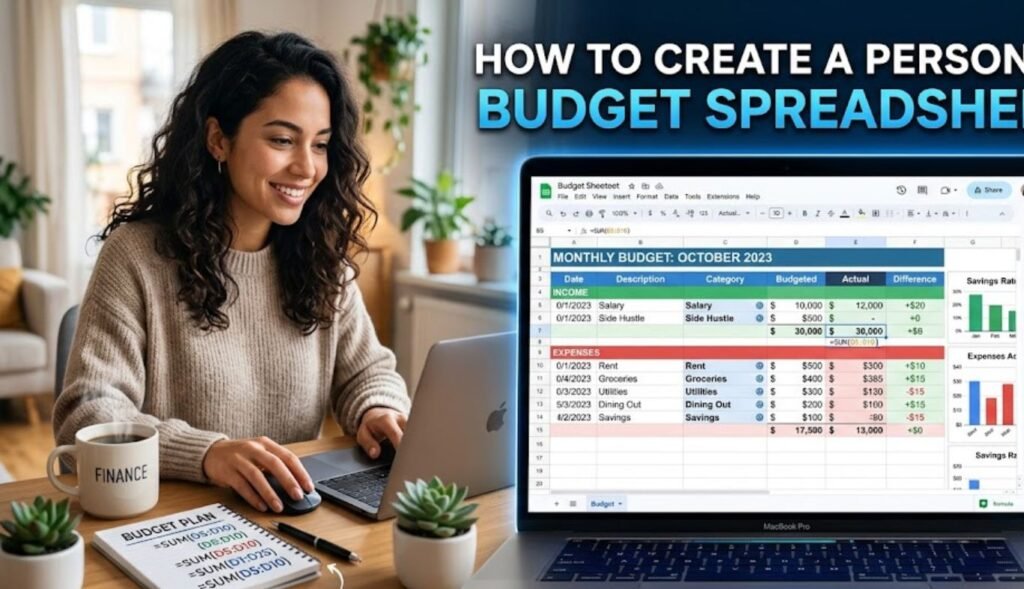
Below is an example of how a simple monthly budget might look.
| Category | Budgeted | Actual | Difference |
|---|---|---|---|
| Income | $4,500 | $4,500 | $0 |
| Housing | $1,400 | $1,400 | $0 |
| Utilities | $250 | $230 | +$20 |
| Groceries | $500 | $470 | +$30 |
| Transportation | $300 | $325 | -$25 |
| Entertainment | $250 | $190 | +$60 |
| Savings | $700 | $700 | $0 |
| Miscellaneous | $200 | $180 | +$20 |
Review this table at the end of each month to identify areas where spending exceeded or stayed below the budget.
Tips for Keeping Your Budget Accurate
Maintaining a budget requires consistency rather than perfection.
Here are several practical tips:
- Update your spreadsheet weekly.
- Record every expense, no matter how small.
- Compare actual spending with your planned budget.
- Adjust categories when your financial situation changes.
- Review monthly progress toward savings goals.
- Keep digital copies of important receipts.
- Back up your spreadsheet using cloud storage.
- Revisit your budget before making major purchases.
Small, consistent updates will keep your budget reliable and useful throughout the year.
Common Budgeting Mistakes to Avoid
Creating a budget is an excellent first step, but maintaining it correctly is what leads to long-term financial success. Many people abandon their budgeting efforts because of avoidable mistakes. By recognizing these common pitfalls, you can build a budget spreadsheet that remains useful month after month.
Setting Unrealistic Spending Limits
One of the biggest mistakes is creating a budget that is too restrictive. If you drastically reduce spending in every category, sticking to your plan becomes difficult.
Instead, review your previous spending habits and create realistic limits that gradually improve your financial situation.
Forgetting Irregular Expenses
Some expenses don’t occur every month, but they still need to be planned for.
Examples include:
- Annual insurance premiums
- Vehicle maintenance
- Holiday shopping
- School fees
- Property taxes
- Birthday gifts
- Home repairs
Add these expenses to your spreadsheet by estimating their yearly cost and dividing them into monthly amounts.
Ignoring Small Purchases
Daily coffee, snacks, online subscriptions, and impulse purchases may seem insignificant. However, these small expenses often add up to hundreds or even thousands of dollars over a year.
Recording every purchase gives you a complete picture of your spending habits.
Not Updating the Spreadsheet Regularly
A budget spreadsheet is only effective if it reflects your current financial situation.
Set aside a few minutes every week to:
- Enter new transactions.
- Review account balances.
- Compare actual spending with planned spending.
- Adjust categories if necessary.
Forgetting Emergency Savings
Unexpected expenses are inevitable. Medical bills, vehicle repairs, or home maintenance can quickly disrupt your finances if you don’t have an emergency fund.
Aim to build savings that cover three to six months of essential living expenses.
Advanced Spreadsheet Features to Improve Your Budget
Once you’ve mastered the basics of how to create a personal budget spreadsheet, consider adding advanced features to improve efficiency and accuracy.
Drop-Down Lists
Drop-down menus help standardize expense categories.
Examples include:
- Housing
- Food
- Transportation
- Healthcare
- Entertainment
- Utilities
- Savings
Using consistent categories makes reports more accurate and easier to analyze.
Data Validation
Data validation prevents accidental errors by restricting the type of information entered into specific cells.
For example, you can:
- Allow only numbers in expense columns.
- Prevent negative income values.
- Limit dates to the current year.
- Restrict category names to predefined options.
This feature keeps your spreadsheet clean and organized.
Conditional Formatting
Conditional formatting automatically highlights important information.
Examples include:
| Rule | Result |
|---|---|
| Spending exceeds budget | Red highlight |
| Savings goal achieved | Green highlight |
| Bills due soon | Yellow highlight |
| Negative balance | Bold red text |
These visual indicators make it easier to identify areas that need attention.
Monthly Dashboard
A dashboard summarizes your financial performance using charts, tables, and key metrics.
Your dashboard can display:
- Total monthly income
- Total expenses
- Savings rate
- Debt reduction
- Largest spending category
- Monthly balance
- Year-to-date savings
Having this information on one page provides a quick overview of your financial health.
Reviewing Your Budget Every Month
Creating a spreadsheet is only the beginning. Regular reviews help ensure your budget stays accurate and supports your financial goals.
Compare Budgeted vs. Actual Spending
At the end of each month, compare your planned spending with what you actually spent.
Questions to ask include:
- Which categories exceeded the budget?
- Which categories stayed under budget?
- Were there any unexpected expenses?
- Can any spending be reduced next month?
This review helps you make informed adjustments rather than guessing where your money went.
Celebrate Small Wins
Budgeting is about progress, not perfection.
Celebrate achievements such as:
- Paying off a credit card.
- Increasing your savings.
- Staying within your grocery budget.
- Reducing unnecessary spending.
- Reaching a financial milestone.
Recognizing progress helps you stay motivated.
Performing an Annual Budget Review
An annual review gives you a broader perspective on your finances.
Review the following:
| Item | Questions to Ask |
|---|---|
| Income | Has your salary increased? |
| Housing | Have housing costs changed? |
| Utilities | Are there opportunities to save? |
| Debt | Which loans have been paid off? |
| Savings | Did you reach your goals? |
| Investments | Are contributions increasing? |
Annual reviews help you prepare for future financial goals and adjust your budget to reflect life changes.
Free Budget Spreadsheet Templates
If you don’t want to build a spreadsheet from scratch, many free templates are available online.
Some popular sources include:
| Platform | Features |
|---|---|
| Microsoft Excel Templates | Professional layouts |
| Google Sheets Template Gallery | Cloud-based budgeting |
| Vertex42 | Personal finance templates |
| Spreadsheet123 | Household budget worksheets |
A useful external resource for spreadsheet templates is:
Choose a template that matches your financial goals and customize it as your needs evolve.
Best Practices for Long-Term Budget Success
Successful budgeting isn’t about perfection. It’s about consistency.
Follow these best practices to maintain a healthy financial routine.
Track Spending Frequently
Waiting until the end of the month can make budgeting overwhelming.
Instead, update your spreadsheet every few days.
Keep Categories Simple
Avoid creating too many categories.
Simple budgets are easier to maintain and understand.
Review Bank Statements
Cross-check your spreadsheet with your bank and credit card statements each month.
This helps identify missing transactions and improves accuracy.
Include Financial Goals
Every budget should support specific objectives.
Examples include:
- Saving for retirement.
- Paying off debt.
- Building an emergency fund.
- Buying a home.
- Funding education.
- Planning a vacation.
When your budget reflects meaningful goals, staying motivated becomes much easier.
Back Up Your Spreadsheet
If you use Microsoft Excel, save copies to cloud storage or an external drive.
Google Sheets automatically stores changes online, providing additional protection against data loss.
Budget Spreadsheet Maintenance Checklist
Use this checklist each month to keep your budget up to date.
| Task | Completed |
|---|---|
| Update income | □ |
| Record expenses | □ |
| Pay monthly bills | □ |
| Review savings progress | □ |
| Update debt balances | □ |
| Compare budget vs. actual | □ |
| Adjust spending limits | □ |
| Backup spreadsheet | □ |
Following this routine ensures your budget remains accurate and reliable throughout the year.
Expert Tips for Better Financial Management
Developing strong financial habits takes time, but these expert tips can help you stay on track.
- Automate savings whenever possible.
- Build an emergency fund before making large investments.
- Avoid lifestyle inflation when your income increases.
- Review subscriptions regularly and cancel unused services.
- Set short-term and long-term financial goals.
- Use budgeting apps alongside your spreadsheet if they simplify tracking.
- Focus on steady improvement instead of striving for perfection.
By combining these habits with a well-designed budget spreadsheet, you’ll gain greater confidence in managing your money and making informed financial decisions.
Frequently Asked Questions
1. How do I create a personal budget spreadsheet from scratch?
To create a personal budget spreadsheet, start by listing all sources of income, followed by fixed expenses, variable expenses, savings, and debt payments. Organize each category into separate rows or columns and use formulas to calculate totals automatically. Review and update the spreadsheet regularly to ensure it reflects your current financial situation.
2. What is the best spreadsheet software for budgeting?
The best software depends on your needs:
| Software | Best For |
|---|---|
| Microsoft Excel | Advanced budgeting and financial analysis |
| Google Sheets | Free cloud-based budgeting and collaboration |
| Apple Numbers | Apple users looking for simplicity |
| LibreOffice Calc | Free offline spreadsheet management |
Google Sheets is an excellent choice for beginners because it is free, automatically saves changes, and works on multiple devices.
3. How often should I update my budget spreadsheet?
Updating your spreadsheet at least once a week is recommended. Regular updates prevent forgotten transactions and help you identify overspending before it becomes a larger issue.
Many people also perform:
- Weekly expense reviews
- Monthly budget comparisons
- Quarterly financial checkups
- Annual financial planning sessions
Consistent updates make budgeting far easier than entering an entire month’s transactions at once.
4. What categories should every personal budget include?
A complete budget should include:
| Essential Category | Examples |
|---|---|
| Income | Salary, freelance work, investments |
| Housing | Rent, mortgage |
| Utilities | Electricity, gas, internet |
| Transportation | Fuel, insurance, maintenance |
| Food | Groceries, restaurants |
| Healthcare | Insurance, prescriptions |
| Entertainment | Movies, subscriptions |
| Savings | Emergency fund, retirement |
| Debt | Credit cards, loans |
These categories provide a clear overview of your financial position.
5. How can I reduce unnecessary spending?
Reducing expenses begins with identifying where your money goes each month.
Helpful strategies include:
- Preparing meals at home.
- Cancelling unused subscriptions.
- Buying only what you need.
- Comparing prices before shopping.
- Setting monthly spending limits.
- Avoiding impulse purchases.
- Tracking every expense.
Even small changes can produce significant savings over time.
6. What is the 50/30/20 budgeting rule?
The 50/30/20 rule divides your after-tax income into three groups:
| Allocation | Purpose |
|---|---|
| 50% | Essential needs |
| 30% | Personal wants |
| 20% | Savings and debt repayment |
This simple framework helps balance everyday spending with long-term financial goals.
7. Can I use a personal budget spreadsheet for my family?
Absolutely. A family budget spreadsheet can include multiple income sources and shared expenses such as housing, groceries, childcare, insurance, transportation, education, and savings goals.
Adding separate categories for each family member can also help track individual spending and encourage financial accountability.
8. How do formulas improve a budget spreadsheet?
Formulas automate calculations, reduce manual errors, and save time.
Some of the most useful functions include:
- SUM() for totaling income or expenses.
- AVERAGE() for calculating average monthly spending.
- IF() for conditional budgeting rules.
- MIN() and MAX() for identifying spending patterns.
Using formulas allows your spreadsheet to update automatically whenever new data is entered.
Final Thoughts
Learning how to create a personal budget spreadsheet is one of the most valuable financial skills you can develop. A thoughtfully designed spreadsheet gives you complete visibility into your income, expenses, savings, and debt, helping you make smarter decisions with your money.
The most effective budget is one that you can maintain consistently. Start with a simple layout, include all major financial categories, automate calculations with formulas, and review your progress every week. Over time, your spreadsheet will become more than just a record of transactions—it will serve as a practical roadmap toward achieving your financial goals.
Remember that budgeting is not about restricting every purchase. Instead, it is about giving every dollar a purpose and ensuring your spending aligns with what matters most. Whether you’re building an emergency fund, paying off debt, saving for a home, or planning for retirement, a personal budget spreadsheet can help you stay organized and focused.
As your income, expenses, and priorities change, continue refining your spreadsheet. Small improvements made consistently can lead to significant financial progress over the long term.
By following the strategies outlined in this guide, you’ll be well equipped to create and maintain a budget that supports financial stability, reduces stress, and helps you build a stronger financial future.